
Localisation of medical or technical content is not a formatting task; it is a risk-management process. When companies treat it as a late, low-cost or automated step, they increase the chances of errors that can affect approvals, safety, credibility and business performance in regulated markets.
In sectors such as pharma, medical devices, engineering, energy, fintech and defence, translated content is often read by people who must act on it: clinicians, patients, regulators, technicians, legal teams and buyers. A mistranslated instruction, inconsistent term or unvalidated AI output can create consequences far beyond awkward wording.
The seven mistakes below are common because they look efficient at first. In practice, they often create rework, delays and exposure that could have been avoided with the right process from the beginning.
1. Why is treating translation as an afterthought so risky?
The first mistake is leaving Localisation planning until the end of the content workflow. By then, the source text may already be approved, designed, locked in complex formats or distributed across several teams and platforms.
This creates avoidable pressure. Translators and reviewers are asked to deliver faster, with less context and fewer opportunities to ask questions. In regulated industries, that is exactly when small inconsistencies can become serious quality issues.
Translation should be planned from day one, especially when content will support product approvals, patient information, technical operations or contractual commitments. Early involvement allows terminology, reference materials, workflows and review responsibilities to be defined before deadlines become critical.
A better approach starts with questions such as:
- Which markets, languages and regulatory contexts are involved?
- Who will approve the translated content internally?
- Which terms must remain consistent across documents?
- Which files, formats and platforms will be used?
- What is the acceptable review and validation process?
When translation is integrated early, teams reduce last-minute decisions and protect both quality and time-to-market.
2. What happens when companies choose providers based on price alone?
The second mistake is treating the lowest quote as the safest business decision. In complex medical or technical content, price-only selection often hides the real cost of poor quality.

A cheaper supplier may lack specialist linguists, structured quality assurance, terminology controls or experience with regulated documentation. The result can be rework, internal escalation, delayed approvals and loss of confidence among stakeholders.
This does not mean that cost is irrelevant. It means cost must be assessed alongside risk, expertise, process and accountability. Translation for a brochure, an internal memo and a regulated product document should not be bought as if they carried the same consequences.
Companies should evaluate providers on practical criteria:
- Proven experience in medical, technical or regulated content
- Clear quality assurance and review stages
- Ability to manage terminology and reference materials
- Secure handling of confidential documentation
- Responsiveness when questions or deviations arise
The right question is not “Which supplier is cheapest?” but “Which supplier reduces the risk of error, delay and non-compliance?”
3. Why does subject-matter expertise matter so much?
The third mistake is assuming that fluency in two languages is enough. It is not. Medical and technical translation requires subject-matter expertise, because the translator must understand both the language and the content logic behind it.
A generalist may produce text that sounds natural but fails technically. In regulated communication, that is especially dangerous because the error may be subtle: a dose, device component, procedural step, claim, limitation or warning may be expressed in a way that changes its meaning.
Medical translation requires control of terminology, patient safety implications, document conventions and the difference between technical precision and plain-language clarity.
Technical translation requires understanding of systems, processes, components, operating conditions and the practical consequences of ambiguous instructions.
Regulated-sector translation requires awareness that every word may be reviewed, queried or relied upon by a professional, auditor, regulator or end user.
Subject-matter expertise also improves collaboration. Specialist translators know when to ask a question, when a term should not be “improved”, and when consistency matters more than stylistic variation.
In regulated content, a translation is not successful because it reads well; it is successful because the right reader can act on it safely and correctly.
4. How does inconsistent terminology create compliance problems?
The fourth mistake is allowing different terms for the same concept to appear across related documents. Terminology consistency is not a cosmetic preference; it is a core quality requirement.
If one document uses one term, another uses a near-synonym and a third uses an internal abbreviation, readers may wonder whether the content refers to the same concept or to different ones. In technical and medical contexts, that uncertainty can affect interpretation, training, reporting and regulatory review.
Terminology management helps prevent this. It gives translators and reviewers an approved reference point for critical terms, product names, procedures, warnings, component labels and recurring phrases.
Good terminology work typically includes:
- Approved glossaries for key terms and expressions
- Clear rules for product names, abbreviations and units
- Alignment across departments and document types
- Updates when source terminology changes
- Reuse of validated terms in future projects
The benefit is cumulative. Each approved term strengthens future work, reduces review cycles and protects consistency across markets.
5. Can AI translate medical and technical content safely?
The fifth mistake is over-relying on AI without expert human validation. AI can be useful for scalability, drafting and workflow support, but human validation remains critical where accuracy, liability and compliance are involved.
AI systems can produce fluent output that looks convincing even when it is wrong. That is a particular risk in medical and technical content, where errors may not be obvious to a non-specialist reviewer. A sentence can sound polished while misrepresenting a procedure, caution, limitation or technical relationship.
The question is not whether AI should ever be used. The question is where it fits safely inside a controlled process. In regulated content, machine-assisted workflows need expert review, terminology control, confidentiality safeguards and clear responsibility for final approval.
Companies should be cautious when AI is used for:
- Patient-facing information or instructions
- Clinical, legal or regulatory documentation
- Safety warnings and adverse-event language
- Technical procedures or operating manuals
- Content with confidential or sensitive data
AI can support productivity. It should not become the final authority on meaning.
6. What quality assurance steps should never be skipped?
The sixth mistake is neglecting structured quality assurance. A translated document may pass a quick read-through and still contain inconsistencies, omissions, formatting errors or terminology deviations. Quality assurance exists to catch what ordinary reading can miss.
In medical and technical content, QA should be multi-layered. Linguistic accuracy matters, but so do numbers, units, formatting, references, tables, labels, regulatory wording and cross-document consistency.
A robust QA process may include translation by a specialist, revision by a second qualified professional, terminology checks, format checks and final validation against client instructions. The exact workflow should match the risk profile of the content.
Skipping QA usually saves time only on paper. If errors are found later by internal teams, regulators, distributors or end users, the cost is higher: rework, delay and damaged trust.
This is why translation quality should be designed as a process, not inspected as an afterthought. The most reliable workflows make errors harder to introduce and easier to detect before delivery.
7. Why should end users shape the translation process?
The seventh mistake is underestimating the people who will use the content. Medical and technical documents are not written for the translation team; they are written for professionals, patients, regulators, technicians, partners or customers who need to understand and act.

That makes end-user clarity essential. A regulator may need exact terminology and alignment with supporting documents. A clinician may need precision without ambiguity. A patient may need clear, accessible wording. A technician may need instructions that work under pressure.
The same source text can therefore require different translation decisions depending on audience, channel and purpose. A highly technical formulation may be appropriate in one document and unsuitable in another.
Companies should define the audience before work begins. Who is reading? What do they already know? What decision or action depends on the content? What level of formality, technical detail and local adaptation is expected?
This is where specialist localisation adds value beyond word transfer. It adapts content so that the intended reader receives the right message, in the right register, without compromising accuracy.
How can companies reduce translation risk in regulated content?
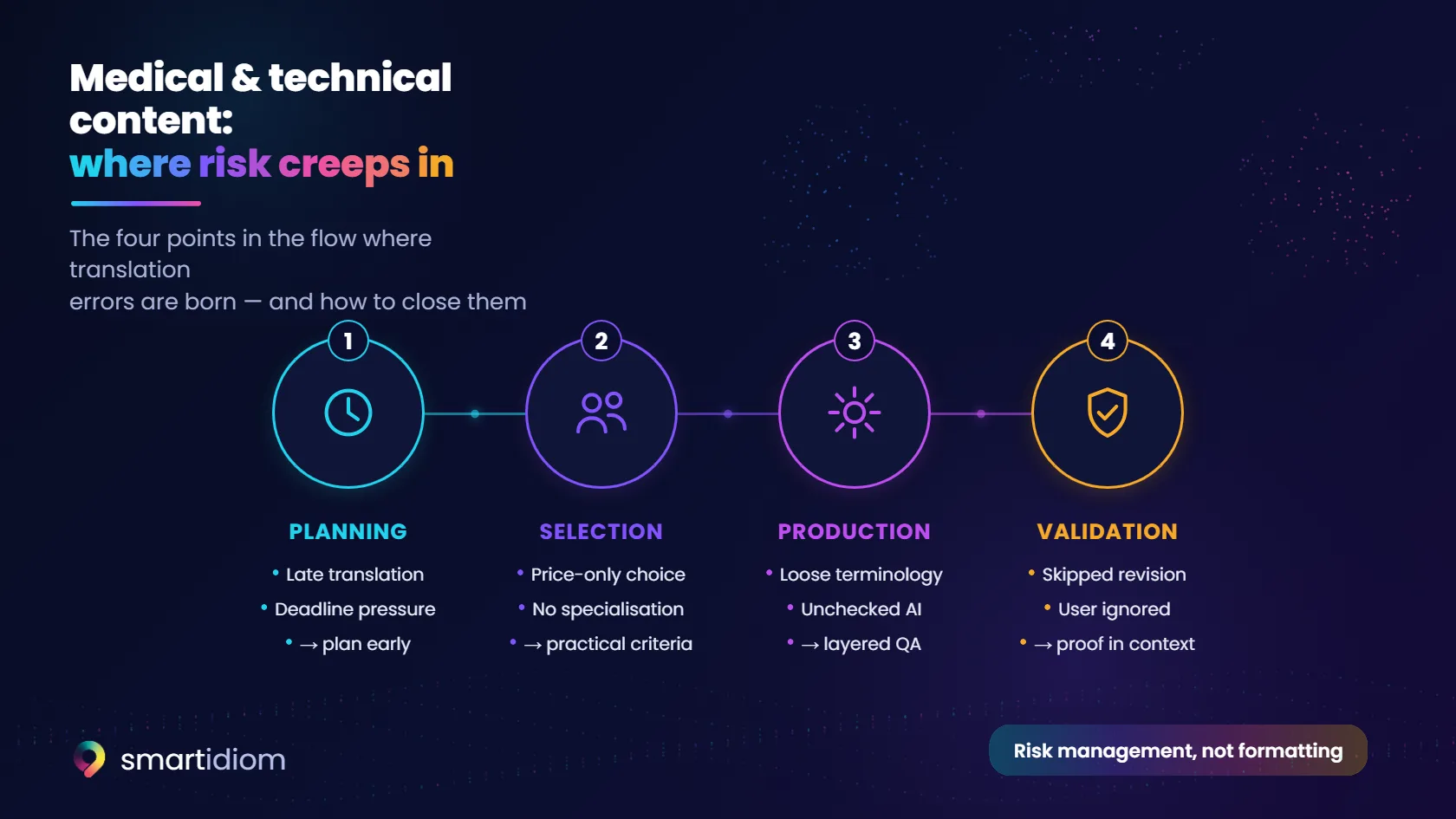
The safest approach is to treat translation as part of the regulated content lifecycle. That means planning early, choosing the right expertise, controlling terminology, using AI responsibly, applying structured QA and keeping the end user in view.
At SMARTIDIOM, a translation company for demanding sectors, this is how we approach complex multilingual work. The aim is simple: less risk, fewer mistakes and content that supports business, regulatory and operational objectives.
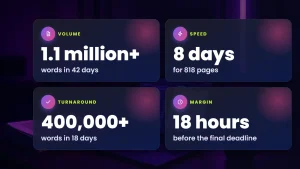
The same principle applies whether the project involves a short technical update or a large multilingual programme. SMARTIDIOM has delivered a 1 million-word project in 5 business days for a company in a highly regulated sector, but speed only works when process, expertise and quality control are built into the workflow.
Localisation should never be the weak link between a company’s knowledge and the people who rely on it. In medical and technical industries, the translation process must protect meaning, compliance and trust at every stage.
Ready to reduce risk in your medical or technical translations? Speak to us
1. Should medical or technical translation always involve a specialist?
Yes. Medical and technical content should be handled by linguists with relevant subject-matter expertise, not only language fluency. Specialist knowledge helps protect accuracy, terminology consistency and suitability for the intended audience.
2. Is AI safe to use for regulated translation projects?
AI can support parts of the workflow, but it should not replace expert human validation in regulated content. Any AI-assisted output should be reviewed for accuracy, terminology, confidentiality and compliance before use.
3. When should localisation be planned in a technical or medical project?
Localisation should be planned from the start, not after the source content is finalised. Early planning makes it easier to define terminology, review steps, responsibilities, formats and market-specific requirements.