
Advertising Translation becomes business-critical when a campaign must do more than sound correct: it must feel native, persuasive and culturally safe. In international marketing, that often means transcreation – recreating the message so the brand’s emotion, intent and flavour survive across markets.
What is transcreation in marketing?
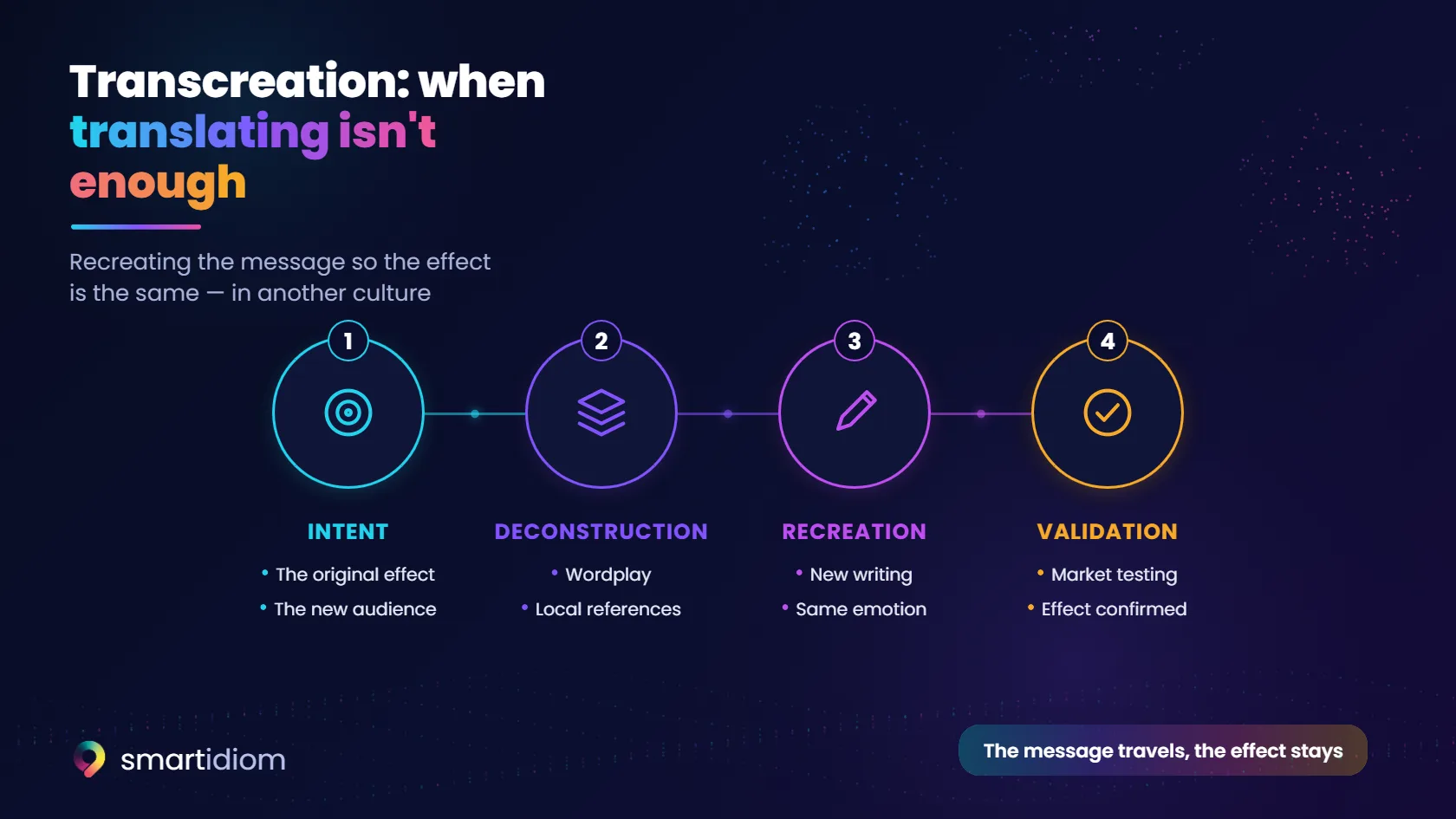
Transcreation is the creative adaptation of a message from one language and culture into another. It keeps the strategic purpose of the original, but allows the wording, rhythm, imagery, humour and emotional cues to change when a literal translation would weaken the campaign.
In advertising, the “right” words are rarely just accurate words. They are words that carry appetite, aspiration, trust, urgency or belonging. A beverage campaign, for example, may need to evoke refreshment, sociability, pleasure or innovation – and each of those feelings may be expressed differently from one market to another.
This is why transcreation sits between translation, copywriting and cultural consultancy. It is not a decorative extra added at the end of a campaign. It is a disciplined way of protecting brand impact when messages travel.
When does Advertising Translation need transcreation?
Advertising Translation needs transcreation when the success of the message depends on emotion, cultural meaning or consumer behaviour. Product facts may be translated directly; a campaign promise often cannot.

A direct translation may be technically correct and still feel flat, forced or inappropriate. The risk is higher when the original copy uses idioms, humour, sensory language, wordplay, cultural references or social rituals. These elements rarely move cleanly from one language to another.
Transcreation is especially relevant when a campaign must answer questions such as:
- Will this message sound natural to local consumers?
- Does the emotional appeal match local expectations?
- Could any phrase carry an unintended meaning?
- Does the brand voice remain recognisable?
- Will the campaign feel local without losing its global identity?
For regulated or reputation-sensitive brands, the stakes are even higher. A poor adaptation can dilute positioning, create confusion or make a carefully built brand sound careless.
What was the challenge for the beverage campaign?
The challenge was to help an internationally renowned beverage brand launch an innovative campaign in several markets while preserving its strength and emotional appeal. The message had to remain faithful to the brand, but also respect the linguistic and social peculiarities of each country.
The brand was not simply asking for language versions. It needed campaign versions capable of working in real consumer contexts. That meant understanding how people talk about taste, occasions, refreshment and shared moments in each market.
A beverage campaign is particularly sensitive to tone. Too formal, and it loses energy. Too playful, and it may feel superficial. Too close to the source language, and it can sound imported rather than desirable.
The goal was therefore clear: maintain the brand’s essence while giving every local version its own cultural flavour.
How did SMARTIDIOM approach the transcreation process?
Our approach began with research into the target markets. Before writing or adapting copy, the team looked at cultural nuances, idiomatic expressions and public preferences relevant to each audience.
This stage matters because transcreation is not guesswork. It requires informed creative decisions: what to keep, what to change, what to avoid and what to recreate from scratch. The original campaign provides the strategic anchor, but the local audience determines the execution.
The work then followed three practical principles:
- Understand the campaign’s emotional core before touching the wording.
- Identify cultural triggers that could strengthen or weaken the message.
- Preserve brand identity across markets without forcing uniform language.
- Validate creative choices before launch.
- Keep the client involved throughout the adaptation.
This balance is central to multilingual marketing. A campaign should not look like several unrelated local ideas, but it should not sound like one message mechanically copied into different languages either.
Transcreation protects the brand’s intention by changing the words when changing the words is the only way to keep the meaning.
Why do native linguists and sector knowledge matter?
Native linguists bring the instinct that no glossary can replace: they know what sounds alive, credible and locally persuasive. In this project, SMARTIDIOM brought together native linguists with marketing experience and in-depth knowledge of the beverage sector.
That combination was essential. Marketing experience helped the team understand campaign mechanics, brand voice and consumer response. Sector knowledge helped shape language around taste, occasion, refreshment and lifestyle without slipping into generic copy.
Cultural nuance was also central. A phrase that sounds elegant in one language may sound exaggerated in another. A metaphor linked to pleasure, freshness or celebration may be inviting in one market and ineffective in the next. The job is not to translate the surface; it is to recreate the effect.
Brand consistency did not mean identical wording. It meant that each version had to feel as though it came from the same brand, with the same confidence and intent, even when the local execution changed.
This is where specialised transcreation differs from a quick adaptation. It requires linguistic judgement, commercial sensitivity and creative restraint.
How does collaboration protect the brand message?
Continuous collaboration with the client kept expectations aligned and ensured that the brand essence was preserved in all versions. In transcreation, collaboration is not administrative; it is strategic.
The client knows the brand’s non-negotiables: positioning, tone, visual identity, campaign ambition and internal sensitivities. The transcreation team knows how those choices may land in each culture. The strongest work happens when both perspectives stay connected.
This dialogue also helps resolve creative trade-offs. A phrase may be memorable in the source language but impossible to reproduce naturally elsewhere. A local version may need a different image, structure or rhythm to achieve the same emotional result. These decisions should be made consciously, not hidden inside a final file.
Good collaboration answers the questions that make or break campaign adaptation:
- What feeling must the audience take away?
- Which elements of the original are essential?
- Where is local creative freedom allowed?
- Which expressions should be avoided?
- How will final approval be managed?
For global brands, this prevents fragmentation. For local audiences, it prevents stiffness. The result is a campaign that remains recognisable while becoming relevant.
Why test a transcreated campaign locally?
Local testing helps confirm whether the adapted message works before launch. For this campaign, SMARTIDIOM carried out tests with focus groups in each market to validate effectiveness and emotional impact.
This step is particularly valuable in advertising because the intended reaction may not be visible from the copy alone. A line can read well internally but fail to connect with consumers. It can also create associations that were not obvious during the adaptation stage.
Testing does not remove the need for expert judgement. It strengthens it. Feedback from local audiences can confirm that a message feels authentic, relevant and emotionally aligned with the campaign’s objective.
In this project, the focus was not only on comprehension. The key question was whether each adapted message retained the campaign’s appeal in a way that felt natural to its audience.
What result did transcreation deliver?
The result was a successful campaign launch and highly positive feedback for authenticity and relevance. Transcreation enabled the brand to connect emotionally with local consumers while strengthening its global presence in a respectful and striking way.

The project confirmed a simple but important lesson: international marketing is not won by linguistic equivalence alone. It is won when a message feels intentional in every market.
For the beverage brand, the value of transcreation was not cosmetic. It helped preserve the campaign’s emotional charge, adapt it to local expectations and support a consistent global identity. That is the difference between being understood and being remembered.
What should brands take from this case?
Advertising Translation should be planned as part of campaign strategy, not treated as a final production step. If a message carries emotional, cultural or creative weight, it needs the right people and the right process from the start.
Brands expanding across markets should brief transcreation teams on more than the source copy. They should share the campaign objective, audience insight, tone of voice, creative rationale and any constraints that affect approval. The better the context, the stronger the adaptation.
At SMARTIDIOM, our work is to build a bridge between brands and consumers. That bridge is grounded in empathy, creativity and, naturally, the right words – not always the same words, but the words that make the message resonate.
Ready to give your international campaign the right local flavour? Speak to SMARTIDIOM
1. What is the difference between translation and transcreation?
Translation transfers meaning from one language to another with accuracy and clarity. Transcreation goes further: it recreates the message so that emotion, tone and cultural relevance work in the target market.
2. Do all advertising campaigns need transcreation?
Not every campaign needs full transcreation, but any message built on humour, emotion, idioms, wordplay or lifestyle appeal should be assessed carefully. If literal accuracy is not enough to persuade, transcreation is usually the safer choice.
3. Why should a brand test adapted campaign messages locally?
Local testing helps verify whether the message feels authentic, relevant and emotionally effective before launch. It can reveal issues that are not visible in the source language or during internal review.