
LSPs need to rethink their translation workflow because client demand has outgrown traditional production models: more content, more languages, tighter deadlines and lower budgets. AI Translation, used with expert post-editing, lets providers increase capacity, protect quality and reduce pressure on linguistic teams before the workflow starts to fail.
The warning signs are usually visible long before a crisis. Project managers spend more time rearranging resources than managing value. Review cycles become inconsistent. Linguists are asked to deliver more, faster, while clients still expect sector-specific accuracy and brand-level polish.
For language service providers, this is not a technology problem only. It is a workflow problem. The question is no longer whether AI can be part of professional translation, but where it belongs, who controls it and how it is checked.
Why are traditional LSP workflows under pressure?
Traditional translation workflows were built for controlled volumes, predictable deadlines and clear human handovers. Today, many LSPs are handling a different reality: continuous content streams, multilingual campaigns, platform updates, product databases, legal files and technical documentation arriving in parallel.
The pressure shows up in familiar ways:
- Linguistic teams become overloaded and less available for high-value work.
- Quality assurance becomes fragmented across tools, reviewers and timelines.
- Deadlines are missed, which weakens client trust.
- Growth depends on urgent recruitment, increasing cost and management complexity.
The problem is not that human translation has lost value. It is that human expertise is often being used in the wrong places: on repetitive, high-volume content that could be accelerated, while specialist linguists are still needed for judgement, nuance and risk.
If an LSP keeps stretching the same process over larger volumes, something eventually gives. It may be margin, quality, delivery time or team morale. Often, it is all four.
What does a smarter AI Translation workflow look like?
A smarter workflow does not replace the existing production model with a black box. It separates content by risk, purpose and expected quality level, then applies the right combination of machine translation, post-editing and human review.

In practice, AI Translation workflow design starts with a simple decision: not all content needs the same treatment. An internal knowledge base is not a regulatory submission. A product listing is not a legal clause. A technical manual is not a global brand campaign.
A hybrid model usually considers:
- Content type: marketing, legal, technical, medical, internal or user-generated.
- Risk level: reputational, legal, commercial, safety-related or low-risk.
- Required turnaround: urgent update, batch delivery or campaign launch.
- Quality expectation: publishable, functional, informative or specialist-grade.
- Terminology control: strict glossaries, client style guides and domain rules.
This is where AI becomes useful: not as a shortcut, but as a production layer. It increases speed where structure and repetition make automation appropriate, while preserving human control where judgement matters.
At SMARTIDIOM, a translation company that is also an LSP, machine translation and machine translation post-editing solutions are designed to match existing LSP workflows, not disrupt them. The objective is simple: increase volume and velocity without compromising the quality promise clients already trust.
Where does machine translation create the most value?
Machine translation creates the most value where content is repetitive, structured, high-volume or time-sensitive. These are the areas where a fully manual approach can consume capacity without adding proportional value.
E-commerce content benefits when large numbers of product listings, descriptions or attributes need to move quickly across markets. The priority is often consistency, speed and controlled terminology rather than highly crafted language in every sentence.
Internal documentation is a strong candidate when organisations need employees to access updates, procedures or knowledge base content in multiple languages. The goal is usually clarity and usability, not advertising-level tone.
User-generated content can be difficult to manage manually at scale. AI-assisted workflows can help LSPs process large volumes while reserving human attention for moderation-sensitive or client-facing outputs.
Product and service portfolios need terminology consistency across many pages, markets and updates. Machine translation, when supported by glossaries and post-editing, can help maintain alignment as content grows.
The key is not to ask, “Can AI translate this?” The better question is, “What level of human intervention does this content need before delivery?”
The smartest LSP workflow is not machine-first or human-only; it is risk-led, quality-controlled and built for scale.
When is human post-editing non-negotiable?
Human post-editing is non-negotiable when accuracy, tone, ambiguity, culture or specialist subject matter can affect the outcome. Machine output may provide a fast draft, but it does not take responsibility for meaning.
SMARTIDIOM works with post-editors who meet the ISO 18587 requirements, which matters because MTPE is not casual proofreading. It is a structured process focused on making machine-translated content accurate, fluent, fit for purpose and aligned with the client’s expectations.
MTPE adds value in four essential ways:
- It corrects mistranslations, omissions and terminology errors.
- It adjusts tone, intent and readability.
- It checks cultural and contextual fit.
- It applies subject-matter judgement where literal output is not enough.
In regulated and specialist sectors, this distinction is critical. Legal documents may leave no room for ambiguity. Medical content may require absolute precision. Technical manuals may depend on exact specifications. Marketing campaigns may fail if the message is linguistically correct but emotionally flat.
This is why AI should not be treated as an independent supplier. It should be treated as an acceleration layer governed by qualified professionals.
How can LSPs protect quality while increasing capacity?
LSPs protect quality by formalising where automation is allowed, where post-editing is required and where full human translation remains the right choice. Without this governance, AI can create inconsistency instead of efficiency.
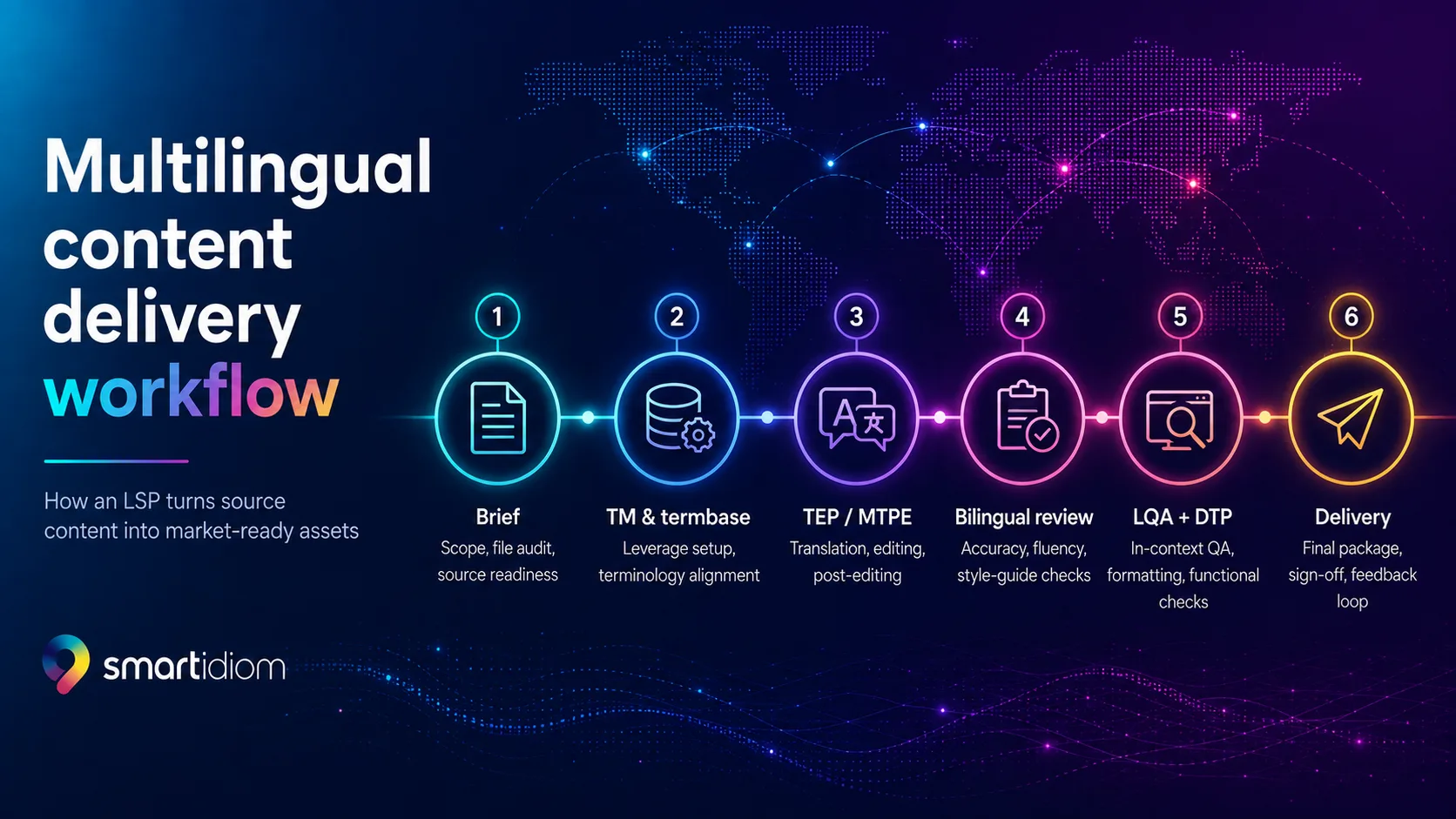
A reliable workflow needs quality gates. These are decision points that prevent unsuitable content from being processed too lightly and ensure that the final output meets the client’s risk profile.
A practical model may include:
- Pre-project content assessment by type, risk and client expectations.
- Engine, glossary and terminology preparation before production.
- MTPE by native linguists with subject-matter expertise.
- QA checks aligned with client style guides and sector requirements.
- Feedback loops to improve consistency across future projects.
SMARTIDIOM’s approach is built around certified quality systems, including ISO 9001:2015, ISO 17100:2015 and ISO 18587. For LSPs, this matters because scalability without process control is not real scalability; it is unmanaged risk.
The goal is to give clients the best of both models: AI-supported efficiency and human-reviewed reliability. That balance is especially important in pharma, legal, fintech, defence, energy and other sectors where language is tied to trust, safety or compliance.
What business results can LSPs expect?
The business case for AI-assisted workflows is strongest when volume is high and the process is controlled. According to SMARTIDIOM’s published service data, LSPs adopting AI-driven workflows with SMARTIDIOM can achieve up to 50% cost savings on large-volume projects and reduce translation times by 30–60%.
Those gains are not just financial. They change how an LSP can operate. More capacity means project managers can accept suitable high-volume work without automatically hiring new teams. Faster turnaround means clients receive multilingual content closer to business speed.
The main benefits are:
- Lower production costs on large-volume projects.
- Shorter delivery times for appropriate content types.
- Increased capacity without immediate recruitment.
- Quality control through native linguists and subject-matter experts.
- Less pressure on internal teams during peaks.
The most valuable result may be less visible: confidence. LSPs can take on more work without forcing every project through the same manual bottleneck. Teams can focus specialist attention where it creates the most value instead of spending it on repetitive content.
Why partner with SMARTIDIOM instead of building everything alone?
Some LSPs can build AI-assisted workflows internally. Many, however, discover that the real challenge is not access to technology; it is building a controlled production model with the right linguists, quality standards and sector knowledge.

SMARTIDIOM supports LSPs that need scalable multilingual production without losing the standards their clients expect. The service combines machine translation, MTPE, certified quality processes and human subject-matter expertise.
There are three reasons this partnership model works.
Workflow fit means the solution is adapted to existing production realities instead of forcing an LSP into a rigid process. The aim is to strengthen delivery, not create operational friction.
Certified quality means production is supported by ISO 9001:2015, ISO 17100:2015 and ISO 18587 frameworks. For LSPs serving regulated or high-stakes sectors, that structure helps protect consistency and accountability.
Breadth of delivery matters when clients require multiple markets, sectors and deadlines. SMARTIDIOM works across 100+ languages and 40+ industries, giving LSPs access to multilingual scale without diluting specialist focus.
The strongest providers in the next phase of the market will not be the largest by headcount. They will be the ones that know when to automate, when to post-edit and when only expert human translation will do.
How should an LSP start rethinking its workflow?
The best starting point is not a full transformation project. It is a focused workflow audit: identify where delays, rework, cost pressure and quality risk are actually happening.
Start with one content stream that is suitable for AI-supported production. Choose something repetitive, high-volume or deadline-sensitive, but not mission-critical enough to create unnecessary risk. Then define the process before scaling it.
A sensible first step includes:
- Mapping current bottlenecks and review loops.
- Selecting content by risk and suitability.
- Defining MTPE quality expectations.
- Assigning specialist post-editors and reviewers.
- Measuring cost, turnaround and client satisfaction after delivery.
This keeps the discussion practical. AI is not introduced as a vague innovation initiative, but as a controlled workflow improvement with clear production goals.
The long-term advantage is resilience. When demand increases, the LSP does not have to choose between refusing work, overloading teams or weakening quality. It has a model designed for multilingual scale.
Ready to build an AI Translation workflow that protects quality and increases capacity? Speak to us
1. Will AI Translation replace human translators in an LSP workflow?
No. In a professional workflow, AI Translation accelerates suitable content, while human linguists control meaning, tone, terminology and risk. The strongest model is hybrid: machine-assisted where appropriate, human-led where quality or judgement is critical.
2. What content should not be handled by machine translation alone?
Legal, medical, technical, regulatory and high-value marketing content should not be delivered without expert human review. These content types require precision, context and accountability that raw machine output cannot guarantee.
3. How can an LSP know if MTPE is worth introducing?
MTPE is worth testing when an LSP handles high-volume, repetitive or time-sensitive content and needs more capacity without weakening quality. A controlled pilot can compare turnaround, cost, reviewer effort and final quality before wider rollout.