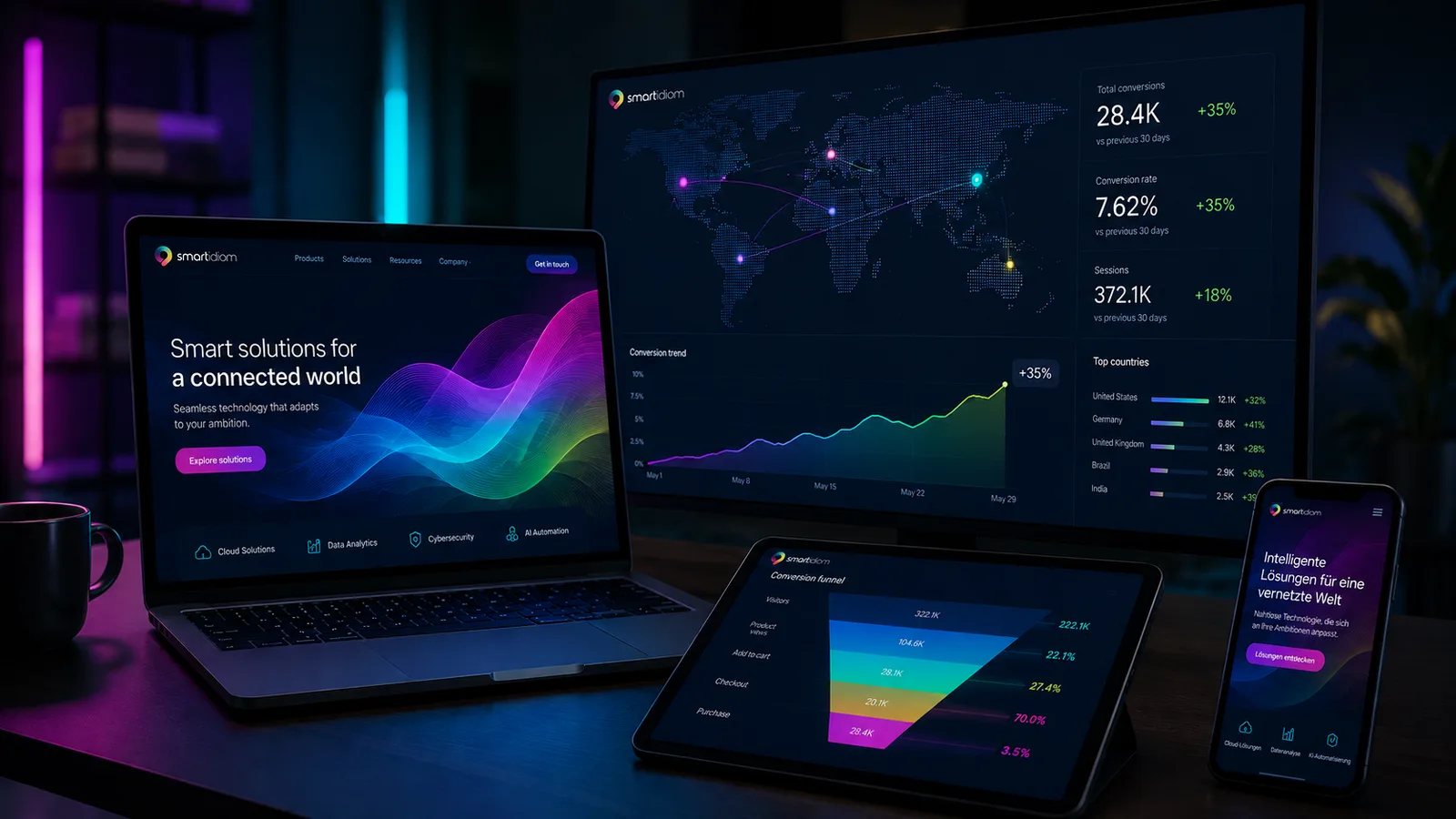
Case study: +35% conversions across 12 new markets
Industry/Sector: Technology and Software (SaaS)
Entering several markets at once is a stress test for a digital product’s content. Every market has its own buying habits, its own objections and its own way of trusting; and copy that is merely “translated” reads as foreign and converts like foreign copy.
SMARTIDIOM supported a global SaaS provider entering 12 new markets, turning localisation from an end-of-line task into an integral part of the release cycle. Six months after the programme started, conversions in the localised markets were up 35%.
The challenge
When the team came to us, the diagnosis was “the translation is fine, but it doesn’t work”. The symptoms were concrete and tangible:
- Conversion rates far below the home market on sign-up and pricing pages – users arrived, read and left;
- Culturally neutral content that avoided local references and concrete examples so it would “work everywhere” – and therefore worked nowhere;
- An end-of-line localisation process: manual exports, several days of waiting per cycle and mismatched versions across markets;
- No way to measure quality; without independent review, quality was just an opinion, not a measured, observed fact.
The goal was to make local content a conversion engine in each of the 12 markets, with quality that could be measured and tracked.
SMARTIDIOM’s strategy
1. Cultural audit, market by market
Before changing a single word, we measured. Native linguists in each market reviewed the existing flows against a shared grid: what was clear, what was correct but “cold” and off-key, and what actively worked against the brand (references that don’t exist locally, formality entirely out of step with the intent, irrelevant examples). The result was a per-market map with priorities – not everything needed transcreation; plenty of informative content needed “only” good technical translation.
2. Terminology and translation memories before production
For each market we created approved glossaries, style guides and translation memories – with product terms validated by the client’s in-house experts. It is the least glamorous step, let’s be honest, but it is what guarantees the button has the same name on the screen, in the e-mail and in the help article, in every market, forever.
3. Transcreation of the critical conversion flows
Sign-up pages, pricing pages, onboarding and transactional e-mails were not translated; they were rewritten by native copywriters – with the original brief, the value proposition and the freedom to rebuild every sentence from scratch. Each piece then went through independent review and, in the main markets, was tested with real users before going live.
4. Multilingual UX: the copy has to fit, stay readable and work
Copy that converts is useless on a screen that cuts it off, right? So we reviewed character limits, truncations, line breaks and in-context screenshots – because German takes up 30% more space than English, and a button cut in half destroys, completely, the trust the copy worked so hard to build.
5. Continuous integration with the client’s CMS
The structural change came when we connected our workflow directly to the client’s CMS. New or changed content entered the localisation circuit automatically; approved content returned automatically to the right place, in the right version. No manual exports, files sent by e-mail or lost versions. Localisation stopped being a separate step and became part of the release cycle.
Challenges overcome
- Launching everything at once created the classic risk: twelve teams pulling in twelve directions. We solved it with prioritisation by commercial impact (i.e. the markets with the highest revenue weight started first) and with native teams working in parallel on the same glossaries and the same style guide, so the brand would sound like one voice in every language.
- Knowing where translation was enough and where rewriting was needed. Transcreating everything would be expensive and slow; translating everything would leave the conversion flows as cold as they were at the start. The cultural audit gave us the map: informative content went through rigorous technical translation, and the pages that sell (sign-up, pricing, onboarding) were rewritten from scratch by native copywriters.
- Integrating localisation without delaying or blocking releases. The client’s biggest fear was the process: each localisation cycle used to cost days of manual exports and mismatched versions. The direct CMS connection removed the problem at the root.
Key performance indicators achieved
- +35% conversions in the localised markets, six months after the programme started;
- 12 new markets served by the same programme, with consistent terminology and tone;
- Localisation integrated into the release cycle, meaning the sprint that shipped a feature also shipped the 12 languages;
- Quality measured by independent LQA on every delivery, with thresholds agreed with the client.
Conclusion
This project shows what changes when localisation stops being a separate step: with a cultural audit, validated terminology, transcreation in the critical flows and continuous CMS integration, local content went from a cost to a genuine growth engine. The process is repeatable, and it is the same start we propose to any company that needs to sell in several markets without multiplying teams, slowing down releases or giving up the rigour its sector demands.
What this client says
We stopped discussing “translations”, as we used to, and started discussing “results”. The content now reads as local in every market, and the team no longer loses days to endless exports and versions.
Director of International Marketing, global SaaS provider