

If you are dealing with Portuguese bureaucracy from abroad, or settling into life in Portugal, sooner or later someone will ask you for a Hague Apostille. This guide explains what it is, when you actually need one, and how it works together with certified translation, whether your documents are coming into Portugal or leaving it.
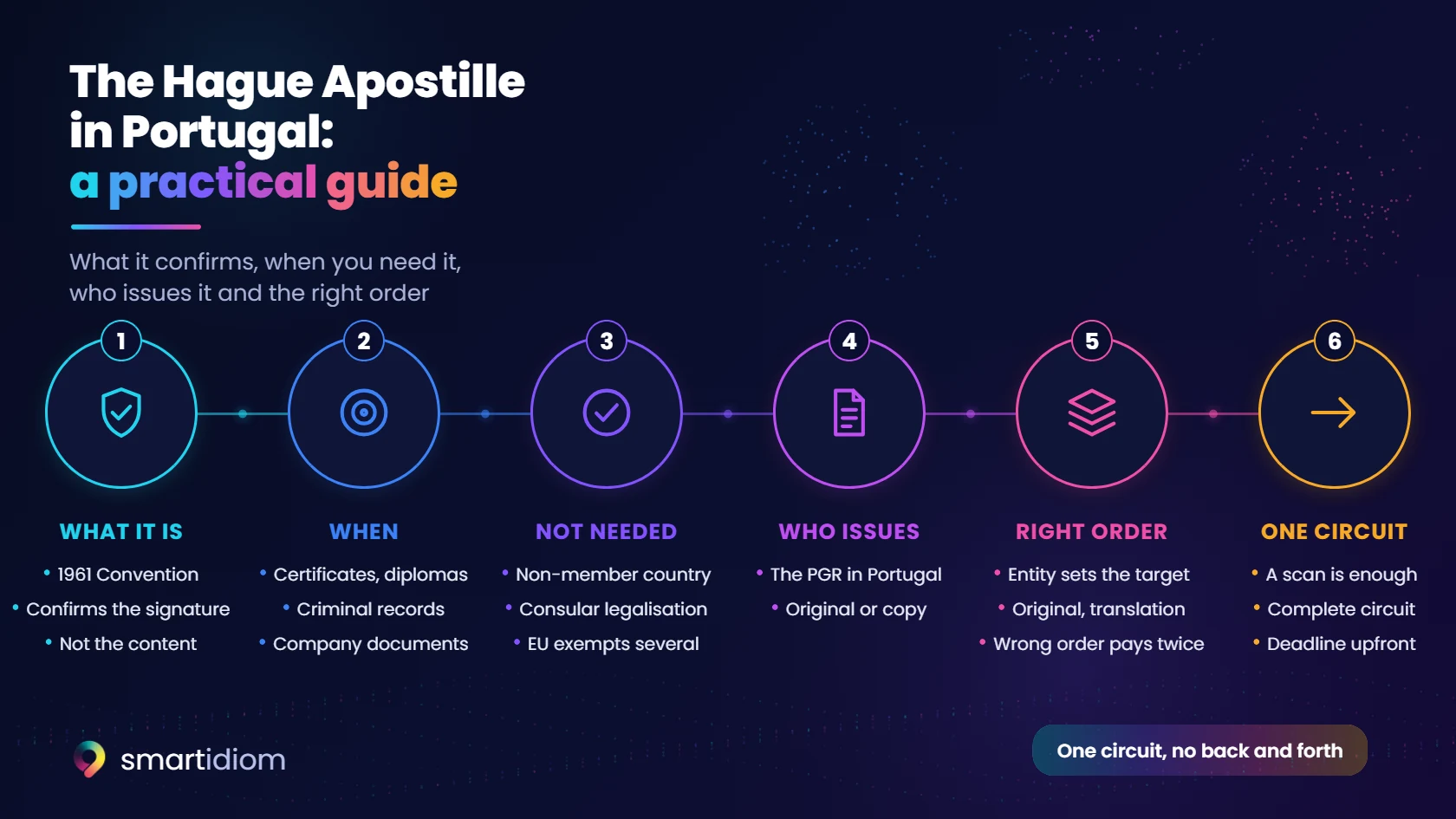
What is the Hague Apostille?
The apostille is a standardised certificate created by the Hague Convention of 5 October 1961. It confirms the authenticity of the signature, seal or stamp on a public document, so that the document is accepted in any other country of the Convention without going through embassies and consulates.
One point that avoids a lot of confusion: the apostille does not validate the content of the document. It validates who signed it and in what capacity. The content stands on its own.
Who typically needs one in Portugal?
In our experience, three groups of foreign clients run into the apostille most often:
- People who have moved to Portugal: birth and marriage certificates for residence permits and civil registrations, criminal record certificates for visas, diplomas for university enrolment or professional registration, foreign driving licences to exchange;
- Companies opening a business in Portugal: certificates of incorporation, powers of attorney, board resolutions and shareholder documents issued abroad, which Portuguese notaries and registries will only accept with the right legalisation;
- People using Portuguese documents abroad: anything issued in Portugal (certificates, court decisions, notarial deeds) that needs to produce effects in another Convention country.
Which direction is your document travelling?
This is the question that decides everything, so we always ask it first:
- Foreign document to be used in Portugal: the apostille must be issued in the country where the document was issued, by that country’s competent authority. It cannot be done in Portugal. Once apostilled, the document usually needs a certified translation into Portuguese to be accepted by courts, notaries and public services here;
- Portuguese document to be used abroad: the apostille is issued in Portugal by the Prosecutor General’s Office (PGR, Procuradoria-Geral da República), and the document usually travels with a certified translation into the language of the destination country. For certificates, see our guide to translating a Portuguese birth, marriage or death certificate for use abroad.
Certified translation in Portugal: there are no sworn translators
This surprises many foreign clients. Unlike Spain, Brazil, Germany or France, Portugal has no official register of sworn translators. What Portuguese law provides instead is the certified translation: a professional translation formally certified before a notary, lawyer or solicitador (a regulated Portuguese legal professional), who attests the identity of the translator and the fidelity of the translation. Read our guide on sworn translators in Portugal for the full picture. That is the format Portuguese courts, registries and public services accept, and the format we prepare every day.
The apostille can then be requested on the original public document, on the notarial certification of the translation, or on both, depending on what the receiving entity requires. If you prefer not to have anything stapled to your original, a certified copy of the document can be made, and the apostille is attached to the certified copy while your original stays intact.
When you do not need an apostille
Two cases worth knowing before you pay for one:
- If the country of origin or destination is not a member of the Hague Convention, the apostille does not apply: the route is consular legalisation, with its own steps;
- Within the European Union, Regulation (EU) 2016/1191 exempts certain public documents (for example, several civil status certificates) from the apostille between Member States. Before paying for one, check whether your document is covered: we tell you in the quote.
Getting it wrong costs twice
Some receiving entities want the apostille on the original with a certified translation attached. Others want it on the certification of the translation as well. Doing it in the wrong order means repeating the process and paying twice. That is why our process always starts with the same question: in which country, and before which entity, will the document be used? With that answer, we set up the complete circuit (translation, legal certification and apostille) and return your document ready to be accepted, with no back and forth.
Handled remotely, wherever you are
You do not need to come to our office at any point. Send us a legible scan and the country of destination, and we handle the rest: professional translation, certification before a notary, lawyer or solicitador, and the apostille itself. If the receiving entity accepts digital documents, delivery is fully electronic. If it requires paper, or the original document itself, everything travels by registered mail with acknowledgement of receipt or by courier, in both directions, anywhere in the world. Request a quote with a scan of your document and we will map out the shortest route, with the deadline stated upfront.