
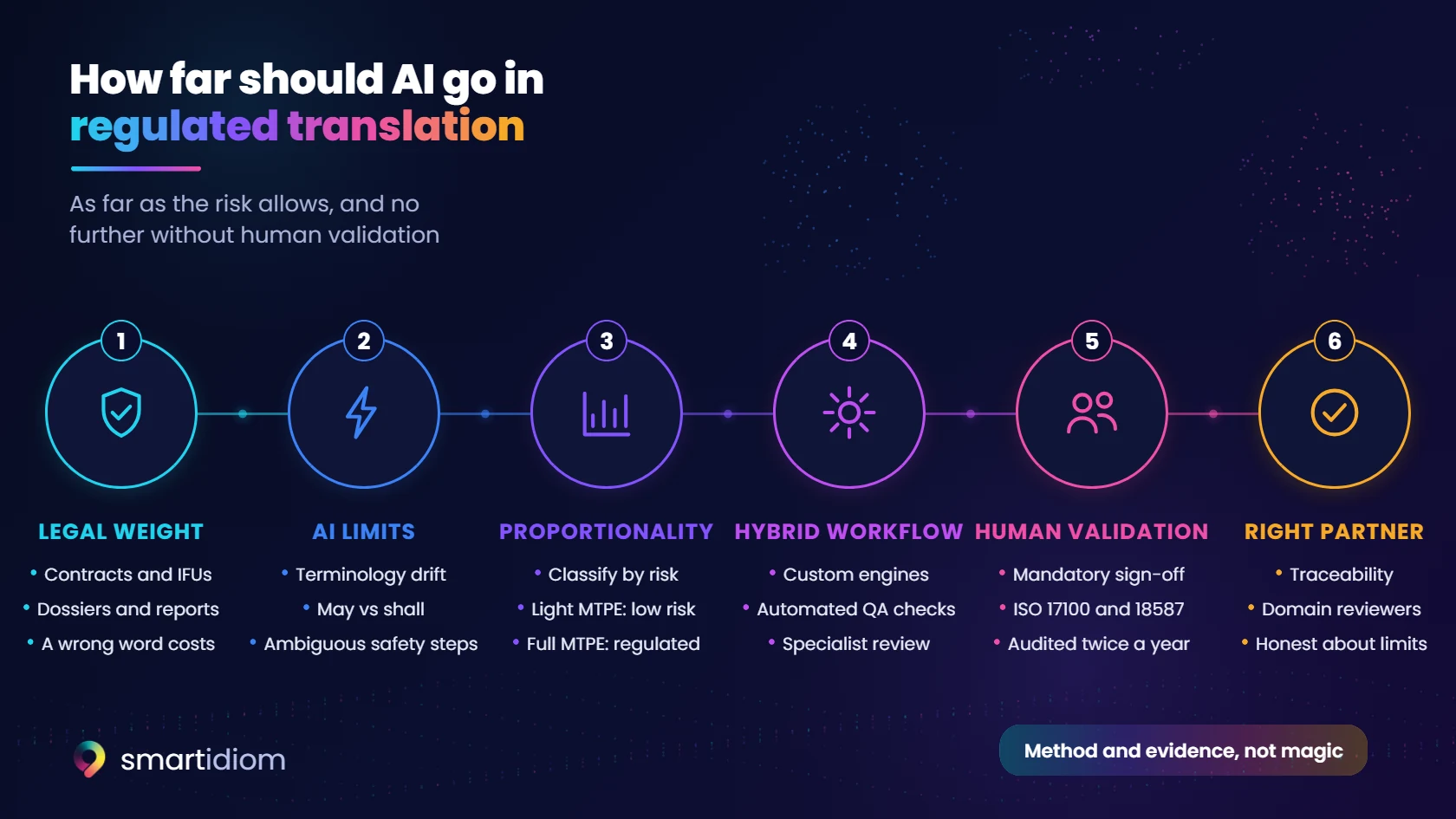
How far should AI go in regulated translation? As far as the risk of the content allows, and no further without human validation. AI in regulated translation accelerates production, but in legal, clinical, financial or compliance documents it is only safe when combined with specialist review, traceability and certified quality control.
By 2026, according to industry research, 83% of language service providers already offer machine translation post-editing and 75% of clients are actively requesting AI-powered solutions. So the question is no longer whether to use AI, but under what conditions it is safe to do so.
In pharmaceuticals, legal, fintech, defence, energy and medical devices, a translation is rarely just a text in another language. It can be documentary evidence, an instruction for use, a contractual clause or a piece of compliance documentation. The right approach is not machine versus human: it is a workflow where each does what it does best.
Why can a translation have legal consequences?
A translation has legal consequences when it alters rights, obligations, risks, instructions or compliance requirements. In a regulated sector, a word is not just a word: it can define a contractual liability, a condition of use or a reporting obligation.
In a medical manual, an ambiguous instruction can affect how a device is used. In a contract, swapping “may” for “shall” changes the obligations between parties. In financial documentation, one misread technical term can lead to compliance failures or decisions based on wrong information.
This is why regulated B2B companies are not shopping for “quick translations”. They want language solutions for businesses that reduce risk, protect sensitive data, shorten time-to-market and help demonstrate diligence to clients, auditors and authorities.
- Contracts, addenda and legal opinions.
- IFUs, clinical documentation and medical device materials.
- Regulatory dossiers and pharmaceutical information.
- Financial reports, internal policies and compliance documentation.
- Technical content for energy, defence and critical technology.
In regulated content, the cost of a wrong word is measured in findings, recalls and rejected submissions, not in style.
What has changed with generative AI in translation?
Generative AI has brought speed, scale and new ways of automating parts of the linguistic process. We are no longer talking about isolated engines: the sector is moving towards multi-agent workflows, where different models collaborate: one translating, another reviewing, another suggesting corrections.
According to the same source, 65% of language service providers were already using generative AI at the start of 2024, double the previous year. Preference for tools such as DeepL reaches 82%, and the global volume of translated content has grown significantly.
This is a genuine opportunity for companies with large multilingual documentation loads. AI can accelerate preliminary versions, support terminological consistency and handle repetitive content more efficiently. But technical efficiency is not the same as legal, clinical or regulatory reliability.
The crucial point is proportionality. The greater the impact of a translation, the greater the human oversight over the outcome should be. Technology improves the process; it does not replace professional responsibility. This is where a well-designed use of machine translation and artificial intelligence separates scale under control from uncertainty at speed.
Where does machine translation fall short with critical content?
Machine translation falls short above all when it needs to interpret specialist context, legal intent or regulatory requirements. Even a fluent-sounding sentence can hide a subtle error that no one without sector expertise would catch.
Imprecise terminology is one of the most common risks. An engine may replace a technical term with a more common synonym, making the text sound more natural but less accurate; and in pharma, legal or finance, that drift can alter the scope of the content.
Loss of legal context is another. Turning “may” into “shall”, or vice versa, can completely change contractual obligations. The sentence stays grammatically correct but becomes legally wrong.
Ambiguity in safety instructions appears in cause-and-effect relationships, numerical ranges and units. Even when the figures are correct, the framing can prompt an incorrect action.
Compliance failures occur when the tool does not recognise terminology approved by health authorities, financial regulators or the client’s internal standards. AI speeds up translation; only a human, specialist and auditable process turns that speed into trust.
When is Automatic Post-Editing appropriate?
Automatic Post-Editing is appropriate when there is specialist human oversight of the outcome and the content type allows a hybrid approach. The right question is not “can we use AI?” but “what is the risk level of this content, and what validation does it require?”.
For low-risk informational content, lighter post-editing may suffice. For regulated content, the bar is different: post-editing must be full, with terminological validation, meaning review, consistency checks and attention to legal or sector requirements.
The distinction is clear. Light MTPE can serve simple informational content. Regulated content requires full post-editing, preferably aligned with ISO 18587, with a quality objective equivalent to traditional human translation.
- Classify content by risk and purpose.
- Define glossaries, instructions and client requirements.
- Choose engines suited to the domain and confidentiality level.
- Apply automated quality checks.
- Validate with translators and reviewers who specialise in the sector.
The right question is never “can we use AI?” but “what is the risk of this content, and what validation does it require?”
Seen this way, AI is part of a process, not a standalone solution. Without clear criteria it generates uncertainty; with method, it delivers scale under control.
How does SMARTIDIOM combine AI in regulated translation with specialists and certifications?
SMARTIDIOM combines customised engines, hybrid workflows and mandatory human validation: harnessing the efficiency of AI without compromising the accuracy, confidentiality and compliance regulated sectors demand.
Customised engines reduce the risk of generic AI applying unsuitable solutions. Trained, customised engines can cut errors by 5 to 10 times, using client-specific bilingual glossaries, specialist term bases and tone-of-voice adjustments.
Hybrid workflows organise the process in layers: content passes through enterprise engines with privacy guarantees, then automated quality checks, then human translation by specialist linguists focused on meaning, terminology, style and compliance.
Mandatory human validation closes the loop of responsibility. The machine accelerates; the specialist validates, corrects and takes ownership of the final quality, essential where an incorrect delivery carries contractual, regulatory or reputational impact.
SMARTIDIOM is certified to ISO 9001, ISO 17100 and ISO 18587, with processes audited twice a year by independent bodies: evidence that helps regulated companies demonstrate diligence in their choice of supplier. ISO 18587:2017 is specific to full post-editing: it sets requirements for post-editor competence, quality objectives equivalent to human translation and procedures for consistent results.
What should you expect from a language partner, and what value does it create?
You should expect traceability, sector expertise and accountability for the outcome. A supplier who only delivers translated words is not enough when a document may be audited, used in court, submitted to an authority or built into an approval process.
A strong partner explains how they classify risk, which profiles are involved, what controls they apply and how they document projects: exactly what you need to show due diligence to auditors, legal teams or regulators.
- Certified, documented processes.
- Reviewers with real domain experience.
- Protection of sensitive data and secure environments.
- Management of terminology, glossaries and preferences.
- Advice on the best approach for each content type.
The business value is direct. A correct translation can support a regulatory submission, avoid legal rework, protect a commercial relationship and reduce divergent interpretations across countries. Translation stops being an administrative step and becomes part of the company’s trust infrastructure. A good partner also helps you choose between human translation, full post-editing, review, cultural adaptation or multilingual marketing strategies, because a critical contract and an institutional brochure never carry the same risk. In regulated sectors, the right partner does not promise magic; it promises method, evidence and the honesty to say when automation is not advisable.
Ready to translate regulated content with more security, speed and control? Request a quote from SMARTIDIOM
1. Can machine translation be used for legal or regulatory documents?
It can, but not on its own for critical documents. In regulated sectors, machine translation should sit inside a workflow with full post-editing, specialist human review, terminological control and documented, auditable processes.
2. What is the difference between human translation and machine translation post-editing?
In human translation, the linguist translates from the original. In post-editing, the starting point is a machine output that specialists review, correct and validate to reach the required quality, especially when applied in a full, ISO 18587-aligned manner.
3. Why are ISO certifications important for regulated companies?
They demonstrate that the supplier follows defined, auditable processes aligned with international best practice. For companies subject to audits, approvals or compliance requirements, that traceability reduces risk and makes the choice of partner far easier to justify.