
If your website only speaks Portuguese, your internationalisation is starting with an unnecessary barrier: many clients arrive, but do not move forward because they do not feel understood. Translating and adapting the site to the right markets helps you build trust, increase conversions and compete where your clients are already searching for solutions like yours.
Imagine walking into a shop in another country, needing help, and nobody understanding you. The experience is uncomfortable, even when the product looks interesting. Online, the same happens: when the page does not speak the visitor’s language, the relationship starts at a distance.
Your website is no longer just a business card. It is a salesperson working every day, at any hour, across several time zones. The question is simple: is that salesperson ready to sell outside Portugal?
Why does language influence the buying decision so much?
The right language reduces friction. When people read a page in their own language, they understand the offer better, misread fewer details and feel the brand thought of them.
According to CSA Research, in a study of consumers across 29 countries, 76% of consumers prefer to buy products with information in their own language. The same study indicates that 40% abandon the purchase if the site is not in their native language.
These numbers reveal a practical truth: buying is not a purely rational decision. Even in markets where English is common, trust grows when the information is clear, local and familiar.
Language sells because it brings people closer. Silence, or a poorly understood message, leaves room for doubt.
What do you lose when your site exists only in Portuguese?
A monolingual site may be limiting your growth without showing up as an obvious problem in the reports. You see traffic, visits and perhaps sporadic enquiries, but you do not know how many opportunities left before asking for a price.

The signs usually hide in simple behaviours: short sessions, abandoned pages, incomplete forms and few contacts from strategic countries.
- International traffic that does not convert: visitors reach the site but leave because they do not fully understand your value proposition.
- Limited local visibility: if you have no content in the market’s language, you have fewer chances of appearing in searches made in that language.
- Weakened trust: vague, literal or poorly translated messages can hurt the perception of professionalism.
- Opportunities handed to competitors: brands that communicate in the right language become easier to choose.
The main loss is not just a sale. It is the initial trust that never gets to form.
Does internationalisation start with translating the website?
Internationalisation does not begin and end with translating the website, but the site is very often the first serious point of contact with a market. Before a meeting, a proposal or a sales call, the potential client researches, compares and evaluates.
If that evaluation happens in a language they do not master, your brand forces them to make an extra effort. In B2B, regulated or technically demanding sectors, that effort weighs even more: nobody wants to make a complex decision with ambiguous information.
Translating the site is therefore a strategic foundation. It helps you align message, credibility and buying intent in each market.
But beware: translating is not copying sentences into another language. An international website needs to reflect local terminology, cultural context, search intent and commercial expectations.
An international website does not just translate what your company says; it translates the trust the client needs to feel in order to move forward.
Translation or cultural adaptation: what is the difference?
Cultural adaptation goes beyond word-for-word equivalence. It ensures the message keeps its meaning, tone and commercial strength when it moves to another market.
A literal translation can be grammatically correct and still fail. It can sound distant, too informal, excessively technical or not credible enough for the target audience. In areas such as pharma, legal, fintech, energy or defence, a poorly handled nuance can create doubt where you should be creating confidence.
Specialised translation ensures terminological rigour, consistency and naturalness. It is essential when the content involves complex products, legal obligations, technical documentation or institutional communication.
Localisation adjusts examples, expressions, units, references and phrasing so users feel the page was designed for their market.
Transcreation is useful when the priority is commercial impact: campaigns, brand messages, slogans, conversion pages and content where emotion and persuasion count as much as precision.
This is where specialised human translation makes a difference: specialised native linguists can preserve what your brand means to say, without sacrificing clarity, rigour or intent.
How does multilingual SEO help clients find you?
Multilingual SEO makes your site findable by people searching in other languages and other markets. Translating a Portuguese page and expecting it to perform the same abroad is not enough.
People do not all search the same way. They may use different terms, different levels of formality or sector-specific expressions in their country. If the translated content does not respect that reality, you can have a page that is correct, and invisible.
A multilingual SEO project should consider:
- search terms used in the target market;
- titles, metadata and URLs adapted to the language;
- search intent per page;
- consistency between content, offer and call to action;
- language variants, when they make a difference.
Website translation should move together with your marketing strategy so each market gets a clear, searchable message aligned with the commercial goals.
When content is designed for local search, the website stops being just a translated shop window. It becomes an international acquisition asset.
Which website content should you translate first?
Not everything has to be done at once. The right priority depends on the markets, the sales cycle and the pages that most influence the decision.
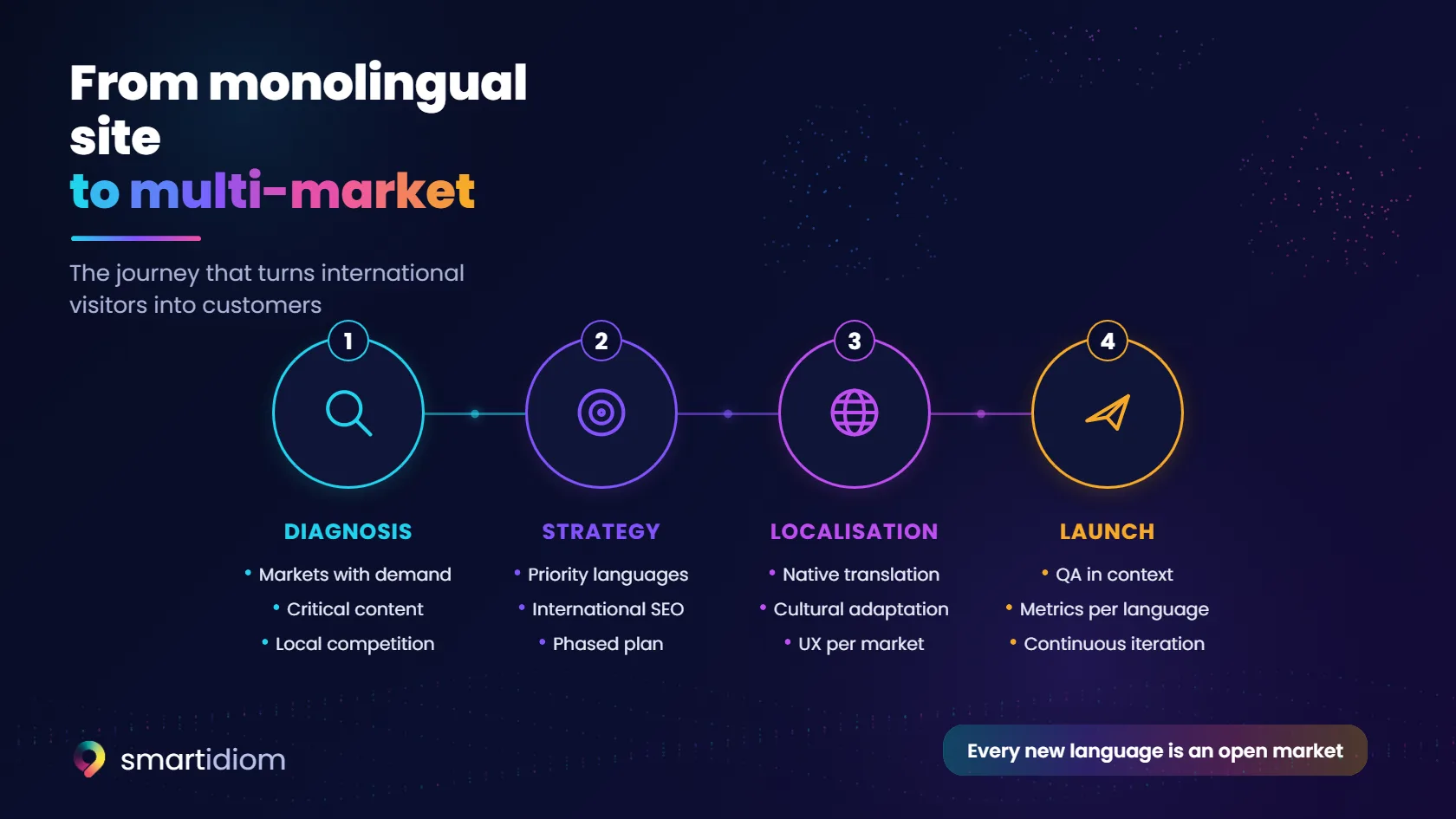
Start with the pages that explain who you are, what you sell and why people should trust you. Then move on to support, proof and conversion content.
- Homepage and value proposition.
- Service, product or solution pages.
- Forms, buttons and contact messages.
- Case studies, testimonials or credentials.
- Legal, technical or support content relevant to the purchase.
In B2B companies, the decision rarely happens in a single visit. So it also pays to translate the materials that help buyers justify the choice internally: brochures, presentations, sector pages and trust-building content.
If you use video, webinars, demos or training, multimedia and accessibility services can adapt subtitling, voice-over and accessible formats for different audiences.
How do you choose the right approach to translating your site?
The best approach depends on the risk, volume, deadline and purpose of the content. Not every page requires the same level of intervention, but every page requires quality control.

Critical content should be handled by human specialists. Institutional pages, commercial proposals, legal information, technical content and regulated materials need precision and accountability.
High-volume content can benefit from technology, as long as there is adequate human review. Machine translation and artificial intelligence can be useful in well-defined workflows, with glossaries, translation memory and validation by linguists.
Brand content demands attention to tone. Your company should sound consistent in every language, without seeming generic or artificial.
Conversion content needs commercial clarity. Buttons, forms, value propositions and trust messages should be adapted to how each audience decides.
For companies, the essential point is balancing quality, time-to-market, risk and return. That is why a language solution should be designed for your business, not treated as an isolated translation task.
What does SMARTIDIOM do differently?
The SMARTIDIOM solution combines linguistic expertise, cultural sensitivity and a multilingual marketing mindset. The goal is not just to publish versions in other languages; it is to make each version work for your business.
In practice, we translate intentions, emotions and outcomes. We keep the rigour where it is mandatory and adapt the message where the client relationship depends on empathy.
We work with native translators and sector specialists, so the content sounds natural and technically safe. This is particularly important in regulated areas, where an imprecise formulation can compromise trust, compliance or reputation.
We also take care of consistency: terminology, tone of voice, calls to action, metadata and user experience. A multilingual website should feel like a solid extension of the brand, not a set of pages added in a hurry.
Your international presence needs to be clear, findable and credible. If you are thinking about growing abroad – or have already started down that path – the internationalisation of your website is not a detail: it is a condition for being taken seriously.
Is your website ready to sell in your clients’ language? Talk to us
1. Is translating the website into English enough?
It depends on the markets where you want to sell. English can help in some contexts, but CSA Research indicates that many consumers prefer to buy in their own language and that a share of them abandon the purchase when the site is not in their native language.
2. Can I use machine translation for the whole site?
You can use technology in some workflows, but critical content needs specialised human review. In regulated or complex B2B sectors, precision, tone and consistency should not be left to the machine alone.
3. Where should I start internationalising my website?
Start with the pages that directly influence trust and contact: homepage, services, products, forms and commercial pages. Then move on to supporting content, such as case studies, technical materials, videos and strategic articles.