
Getting married abroad, applying for citizenship or a residence visa in another country, settling an inheritance outside Portugal. Almost all of these start with a Portuguese certificate, translated and accepted where it is submitted. This guide explains how to have a Portuguese birth, marriage or death certificate translated for use abroad, when it needs an apostille, how long it takes and what the price includes.
Step 1: confirm the country and the authority that will receive the certificate
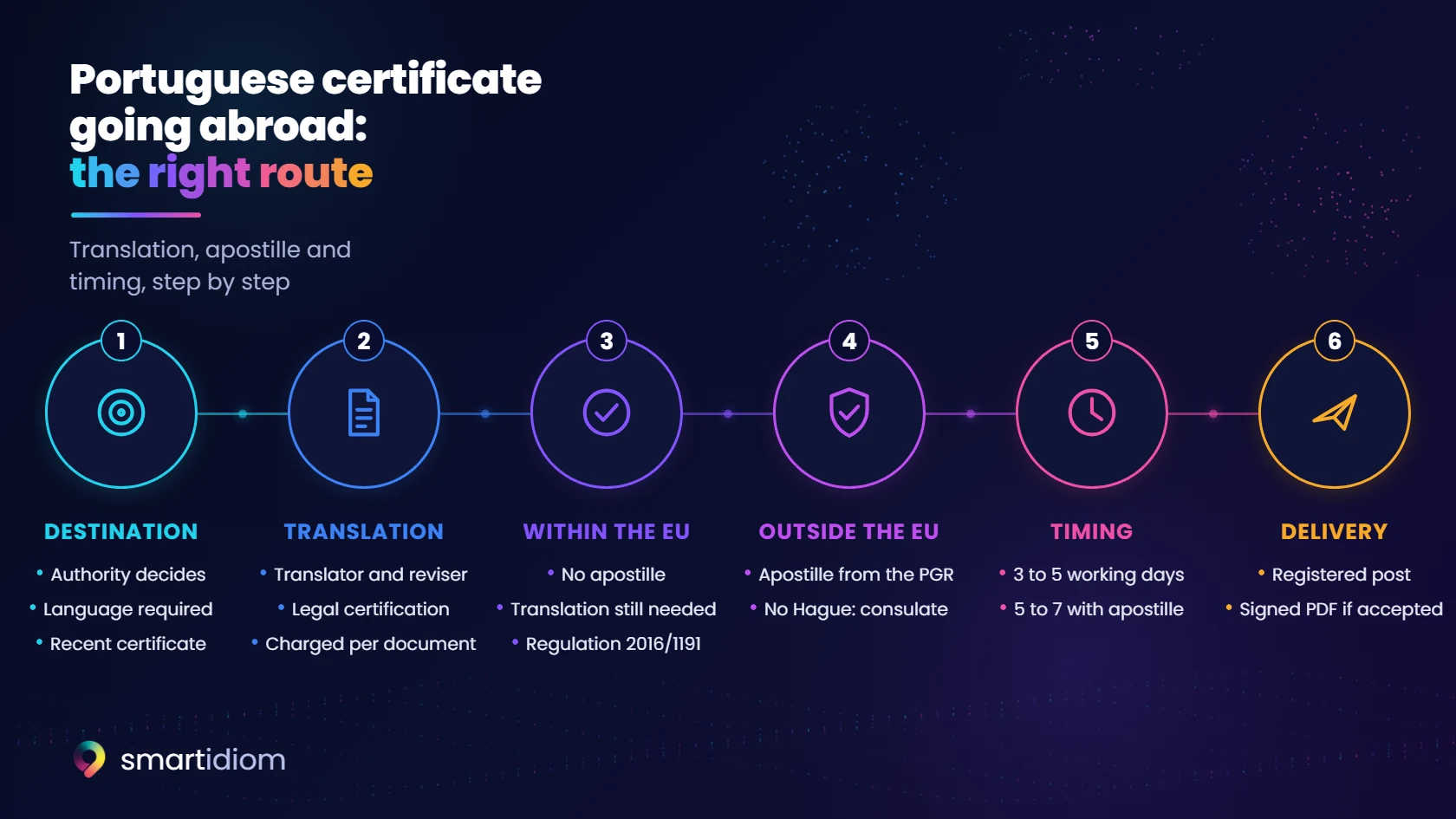
The destination decides everything else. The same birth certificate may need a translation and an apostille for the United Kingdom, consular legalisation for Angola and, for Spain, only a translation, provided the Spanish office accepts one certified in Portugal. Before you order anything, check three things with whoever will receive it: which language it wants, whether it accepts paper or a signed PDF and whether the certificate must have been issued recently. As some authorities only accept recently issued certificates, request yours as close as possible to the date you will submit it.
Step 2: who can certify the translation?
Portugal has no state-appointed sworn translators. What Portuguese public bodies accept, and so do many abroad, is a certified translation: a professional translator translates the certificate, a second linguist revises it, and the translator’s declaration that the translation is faithful is certified before a lawyer, a solicitador (a regulated Portuguese legal professional) or a notary. Certification is charged per document, whether the certificate has one page or three.
Within the European Union, for the certificates covered by Regulation (EU) 2016/1191, a certified translation made in Portugal must be accepted in the other member states. Outside the EU, some countries, such as Brazil, have their own sworn translators, and some only accept their own. We explain the difference in Sworn translation or certified translation in Portugal: which one do you need?
Step 3: does the certificate need an apostille? It depends on the country
- Within the European Union, birth, marriage and death certificates are exempt from the apostille and from legalisation under Regulation (EU) 2016/1191. Note: the exemption does not cover the translation, which is still needed, unless the receiving office accepts the regulation’s multilingual standard form.
- In a Hague Convention country outside the EU, such as the United Kingdom, the United States or Brazil, the certificate generally needs an apostille, issued in Portugal by the Prosecutor General’s Office (PGR). Requirements vary: some want it on the original, others on the certification of the translation, and some on both. The details are in our guide The Hague Apostille in Portugal: a practical guide for foreigners.
- In a country outside the Convention, such as Angola, Mozambique or the United Arab Emirates, there is no apostille: the Portuguese Ministry of Foreign Affairs authenticates the signature of the lawyer, solicitador or notary who certified it, and then the embassy or consulate of the destination country in Portugal legalises the document.
Going the other way? A foreign certificate for use in Portugal is apostilled in the country that issued it, and then translated here: see certified translation for AIMA, IRN and the courts.
How long does a certificate translation take?
As a guide, a one-page certificate takes 3 to 5 working days from scan to certified translation without an apostille, and 5 to 7 working days with one, plus the PGR’s own processing time. If it is urgent, we speed up the translation, revision and certification; the apostille is in the PGR’s hands, so that part cannot be rushed. The quote always states the turnaround time.
What does the price of a certificate translation include?
The price is made up of separate items, and you only pay for the ones your case needs: translation and revision per word, certification per document, the apostille per document where required, and registered post. The final price may be different: it depends on the turnaround time (an urgent order may cost more), linguist availability (which changes during holiday periods), the language pair, the condition of the document, the requirements of the receiving authority and the number of copies. Before we start, you receive a free quote listing each item. If you need more than one copy, the translation is paid once and each extra copy is charged only for certification (and the apostille, where required).
On paper or as a signed PDF?
In some cases, we can deliver the certified translation as a PDF with a qualified electronic signature, which has a legal effect equivalent to that of a handwritten signature across the European Union, and the Prosecutor General’s Office (PGR) can issue an electronic apostille on that PDF. This option has to be confirmed case by case: it depends on the document, the country and the receiving authority, and many foreign authorities still require paper. Tell us where the certificate is going and, before we start, we will tell you whether this option is possible; acceptance is always up to the receiving authority. For consular legalisation, plan for paper.
How we can help
Send us a scan of the certificate and tell us the destination country and the office that will receive it. We will tell you which steps apply and send you a quote with the turnaround time for your case. We then handle the translation, certification and apostille where required, and send the documents by registered post to you or directly to the receiving office. Request a quote.