
Localisation can delay regulatory approval when translated content creates doubt: inconsistent terminology, mismatched labels, unclear instructions or missing updates across language versions. In regulated sectors, authorities review multilingual submissions for clarity, consistency and compliance, not just linguistic equivalence. If one version does not align, approval can slow down while teams correct, justify and resubmit content.
Why does localisation matter to regulators?
Regulators do not assess only the source file. They review the materials submitted for their market, in their language, against the expectations of their regulatory framework. That means your translated content is not a support asset; it is part of the evidence they use to judge whether a product, service or filing is clear, controlled and compliant.
In practice, multilingual consistency is a regulatory signal. If terminology changes from one document to another, or if a warning sounds weaker in one language than in another, the submission can appear less controlled. Even when the underlying product is sound, the documentation may raise questions.
This matters across regulated sectors where documentation carries legal, technical or clinical weight. Pharma product information, fintech customer disclosures, legal agreements, defence specifications and energy compliance files all depend on precise language. The risk is not that a sentence sounds awkward; the risk is that it changes interpretation.
Where does poor localisation usually go wrong?
Poor localisation creates uncertainty where regulators expect certainty. The most common failures are rarely dramatic at first glance. They are small inconsistencies that accumulate across documents, labels, forms, instructions and updates.

Typical problems include:
- Different translations for the same regulated term across files.
- Dosage, safety or usage instructions that are grammatically correct but ambiguous.
- Labels that do not match the wording used in the supporting dossier.
- Updates made in one language but not reflected across all markets.
- Local requirements overlooked because the process treated translation as a late-stage task.
The issue is not only linguistic quality. It is regulatory alignment. A translation can be fluent and still be wrong for approval if it ignores approved terminology, national requirements, product history or the relationship between documents.
This is why regulated content needs more than a general language review. It needs controlled terminology, market awareness and documented quality checks. Without that structure, teams may discover the problem only after the submission has already been questioned.
How can one inconsistent term delay approval?
One inconsistent term can force a reviewer to ask whether two documents refer to the same concept, the same product feature, the same obligation or a different requirement. That question creates friction. Once doubt enters the review process, the burden shifts back to the submitting company to explain and correct.
Terminology control is therefore not cosmetic. In regulated environments, terms carry approved meaning. A product component, adverse event, financial risk, contractual obligation or safety instruction may have a preferred wording because that wording has already been validated.
If a term is translated one way in the product information, another way in the labelling and a third way in the supporting submission, the reviewer has to interpret the relationship between them. That interpretation should never be left to chance.
In regulated markets, localisation fails when it makes reviewers work harder to trust what should already be clear.
The same applies to formatting, references and version history. If a change is introduced in one language and not mirrored in another, the issue may look like weak document control. The regulator may then ask for clarification, updated files or evidence that the inconsistency does not affect compliance.
What is the real cost of delayed approval?
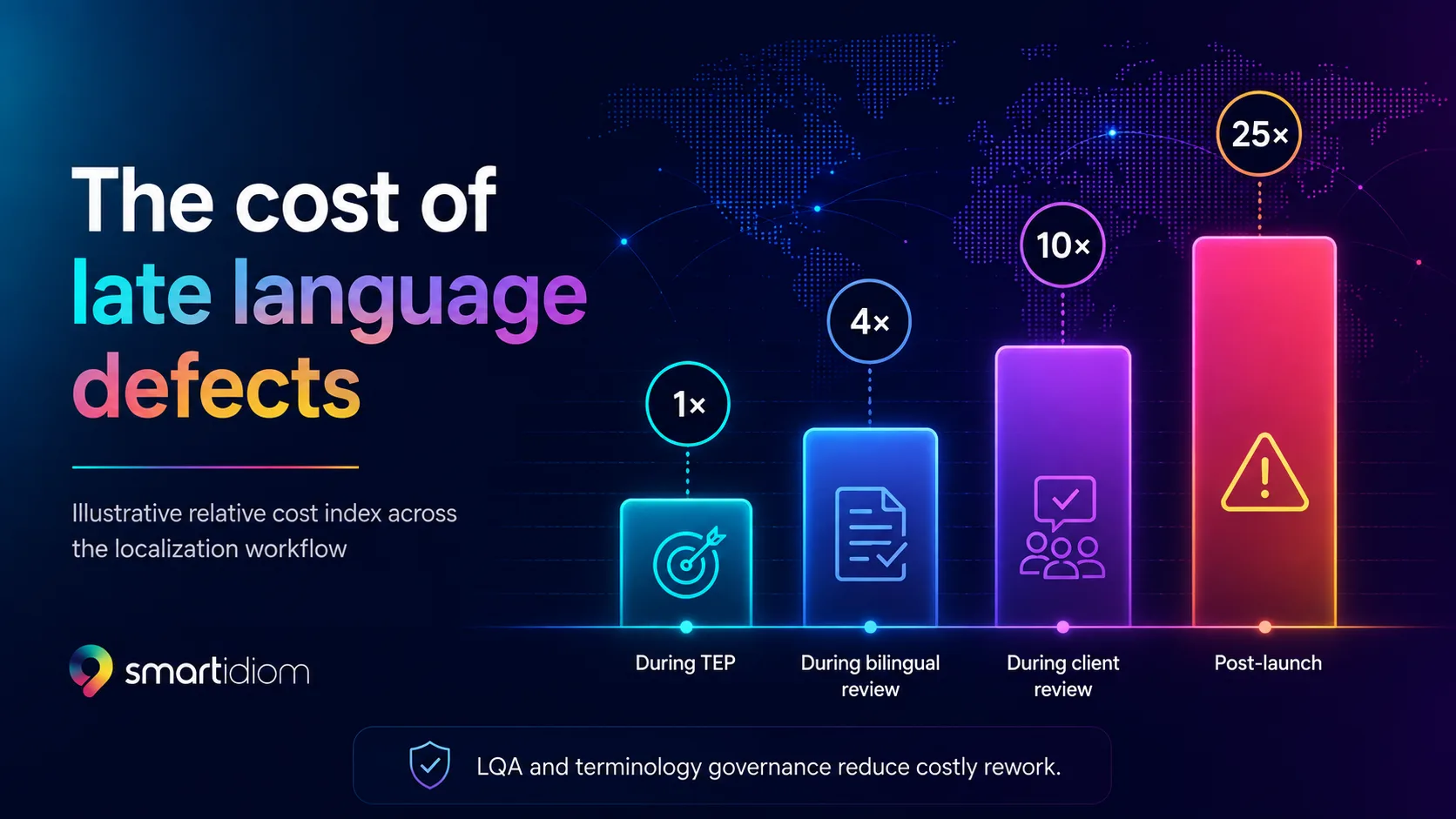
When localisation fails, the consequences extend beyond translation. A delayed approval can postpone a launch, disrupt market entry and put commercial plans under pressure. It can also force internal teams into urgent rework when they should be focused on execution.
The operational cost is often felt across several functions at once. Regulatory affairs must answer questions. Legal or compliance teams may need to review revised wording. Product, marketing or medical teams may have to confirm which language reflects the intended meaning. Project managers then have to coordinate corrections under tighter timelines.
The commercial cost is just as important. In competitive markets, being late can mean losing momentum, missing a planned launch window or giving competitors more time to establish themselves. A localisation issue may appear small, but its effect can move through the whole approval chain.
The deeper problem is that preventable rework consumes expert time. These are usually not generic documents that anyone can fix. They require people who understand the product, the terminology, the local market and the regulatory context.
Why is treating translation as the final step risky?
Many companies still create content in one language, finalise it internally and then send it for translation near the end of the process. In regulated sectors, that model is fragile. It leaves too little time to solve terminology issues, align local requirements or check consistency across all materials.
The better approach is localisation by design. That means planning multilingual content before the last mile, not after it. Teams should know which markets are involved, which documents are connected, which terminology is controlled and which reviewers must validate the final versions.
A stronger workflow usually includes:
- Approved glossaries and style rules before translation begins.
- Clear ownership for terminology and regulatory decisions.
- Version control across every language and document type.
- Early input from subject-matter experts.
- Quality assurance checkpoints before submission.
This does not slow the project down. It reduces avoidable stops later. When localisation is embedded early, questions are resolved before they become regulatory queries.
Can AI prevent localisation errors in regulated content?
AI can accelerate parts of multilingual production, but it cannot ensure compliance on its own. It can support drafting, comparison, terminology suggestions and workflow efficiency. However, regulated content requires accountability, context and validation.
Where does the responsibility sit if an AI-generated phrase changes legal or clinical meaning? That is the question regulated companies cannot ignore. In high-risk content, speed is useful only if the output remains controlled.
Human validation remains essential because nuance matters. A technically acceptable translation may still be unsuitable for a specific filing, jurisdiction or approved product history. A subject-matter expert can identify that risk; an automated process may not.
Technology is most valuable when it sits inside a governed workflow. Translation memories, terminology databases, automated checks and AI-assisted tools can all help, provided they are managed by specialists who know when to accept, adapt or reject the output.
What do high-performing companies do differently?
High-performing companies treat multilingual content as a strategic compliance function. They do not wait until the submission is nearly complete before asking whether the translated versions are consistent. They build language control into the project from the start.

Strategic localisation usually changes three things: planning, accountability and review. Planning defines what must be localised, for which markets and under which requirements. Accountability makes clear who owns terminology, approvals and updates. Review ensures every language version is checked before it reaches the regulator.
This approach is especially important when a company is filing across multiple markets. The more languages, document types and stakeholders are involved, the greater the risk of divergence. Without a centralised process, each update becomes a potential source of inconsistency.
At SMARTIDIOM, this is the environment we work in: specialised translation and multilingual marketing for regulated B2B sectors, where accuracy, clarity and timing matter. Projects such as patent portfolio localisation for multi-market filing show why language decisions must support the regulatory objective, not sit outside it.
How should regulated companies reduce localisation risk?
The best way to reduce risk is to make multilingual content auditable, consistent and reviewable. That means creating a process where language decisions are recorded, terminology is controlled and updates move through all relevant versions.
Start by identifying which documents are connected. A label, instruction, contract clause, product description and submission dossier may not look like one content system, but regulators and users often read them together. If they do not align, the company carries the risk.
Then define the review path. Specialist linguists, subject-matter experts and regulatory stakeholders should not be brought in randomly. Their roles should be clear, especially when changes affect meaning, compliance obligations or local requirements.
Finally, keep the process active after the first submission. Regulated content changes over time. If one market receives an update, the localisation workflow must show whether other languages also need revision.
A practical risk-reduction checklist includes:
- One controlled glossary for approved terminology.
- One source of truth for version control.
- Documented review by qualified specialists.
- Market-specific checks before submission.
- A clear process for post-approval updates.
Localisation should make approval easier by removing ambiguity. When it is planned, governed and validated properly, it helps regulators see the same controlled message in every language.
Ready to reduce approval risk across markets? Speak to SMARTIDIOM
1. Can a good translation still cause regulatory problems?
Yes. A translation can be fluent and accurate in general language terms but still fail if it does not follow approved terminology, local requirements or the wording used in related documents. In regulated sectors, suitability depends on compliance context as well as language quality.
2. When should localisation begin in a regulated project?
It should begin during planning, before the content is treated as final. Early involvement allows teams to define terminology, identify market-specific requirements and prevent inconsistencies from spreading across documents and languages.
3. Is AI safe to use for regulated localisation?
AI can support efficiency, but it should not replace expert review or compliance validation. Regulated content needs human accountability, subject-matter knowledge and quality assurance at every critical stage.