
Procuring translation services without clear criteria can generate delays, rework, inconsistencies and compliance risks. The three most common mistakes are choosing on price alone, ignoring the type of content and not demanding consistency or quality control from the start.
When your company translates technical, legal, commercial or regulatory content, it is not just “putting text into another language”. It is protecting critical information, reputation, sales and trust. Procurement should therefore assess risk, expertise, process and continuity – not just the figure on the proposal.
Why is procuring translation not a commodity purchase?
Business translation is an operational decision with direct impact on compliance, time-to-market and brand perception. If the content is critical, an error is not confined to grammar: it can raise doubts in the client’s mind, delay internal validations or force the revision of documents already distributed.
The problem is that many purchasing processes treat translation as a commodity. Three quotes are requested, the price per word is compared and the lowest figure wins – without assessing who translates, how they review, what tools they use or what experience they have in the sector.
The right question is not just “how much does it cost?”. It is “how much risk does this supplier reduce?”. For B2B companies, especially in regulated sectors, the right partner should combine specialised human translation with clear processes, terminology management and validation suited to the type of content.
- Who will translate and review?
- What experience exists in your sector?
- How is consistency guaranteed across documents?
- What process exists for technical queries?
- How are versions, glossaries and memories managed?
Mistake 1: choosing on price alone
Price matters, but it cannot be the only criterion. When you choose solely on the lowest figure, you take critical factors out of the equation: expertise, review, control, project management and responsiveness.

The result may seem acceptable at delivery, only to reveal problems later. Inconsistent terms, ambiguous sentences, context errors or misalignment with internal terminology end up demanding constant revision. What was “saved” at the start reappears as team time, corrections, delays and frustration.
A low price is not automatically bad. It becomes a problem when it is achieved at the expense of essential stages: content analysis, selection of suitable linguists, review by a second professional, terminology control and version management.
There is also an invisible cost: your team starts doing the work that should have been included in the service. Instead of validating business content, they end up correcting language, aligning terms and explaining context that was never requested at the outset.
Good procurement compares proposals by the relationship between cost, risk and expected outcome. For low-criticality content, a solution combining machine translation and artificial intelligence with human review can make sense. For technical, legal or regulatory documentation, the choice should favour expertise and process traceability.
What should you assess beyond the quote?
Before awarding the work, assess the proposal the way you would assess any supplier handling your company’s sensitive information. Translation goes into contracts, manuals, interfaces, reports, campaigns, datasheets and product documentation. The risk varies, but it is always there.
Procurement criteria should include people, process and proof of suitability. Promising “quality” is not enough; the supplier needs to explain how it is produced and verified.
- Linguists specialised by technical area.
- Independent review and validation where the content demands it.
- Terminology management, glossaries and translation memories.
- A process for queries, changes and versions.
- The ability to maintain consistency across languages and phases.
If the proposal does not clarify these points, your company is buying a vague promise. And the more critical the content, the less acceptable it is to depend on goodwill, speed or price alone.
A good business translation is not the one that looks cheapest; it is the one that reduces risk, prevents rework and keeps your message consistent across every market.
Mistake 2: not considering the type of content
Not all translation projects carry the same risk. Translating an institutional post is not the same as translating legal documentation, instructions for use, contracts, technical reports or materials linked to regulated products.
Content type defines the process. Technical, legal, financial, pharmaceutical, defence or energy content demands specific knowledge, controlled terminology and the ability to grasp contextual implications. Without that, an apparently correct sentence can be technically wrong.
A mistranslated term can raise doubts for the user, delay internal approvals or create compliance problems. In regulated sectors, the problem is rarely just “it sounds off”. More often it is “it does not match what it has to match”.
Legal content demands conceptual precision, coherence between clauses and attention to jurisdiction and contractual context.
Technical content demands command of terminology and consistency across manuals, interfaces, datasheets and support documentation.
Pharmaceutical or medical content demands absolute rigour in product documentation, instructions, warnings, nomenclature and applicable requirements.
B2B marketing content demands adaptation to the market without losing positioning, value proposition or technical credibility.
Procurement should therefore start with content classification. What is critical? What is public? What is regulated? What will be used by clients, auditors, partners or sales teams? Only then does it make sense to define methodology, team and timeline.
Mistake 3: not guaranteeing consistency over time
Inconsistency rarely shows up in the first project. It becomes visible as volume grows: more documents, more languages, more versions, more teams, more markets. That is when different translations of the same term start creating noise.
Terminology consistency is essential to protect the brand and reduce internal effort. If the same feature, product, clause or concept appears translated in different ways, clients hesitate, sales teams improvise and documentation loses authority.
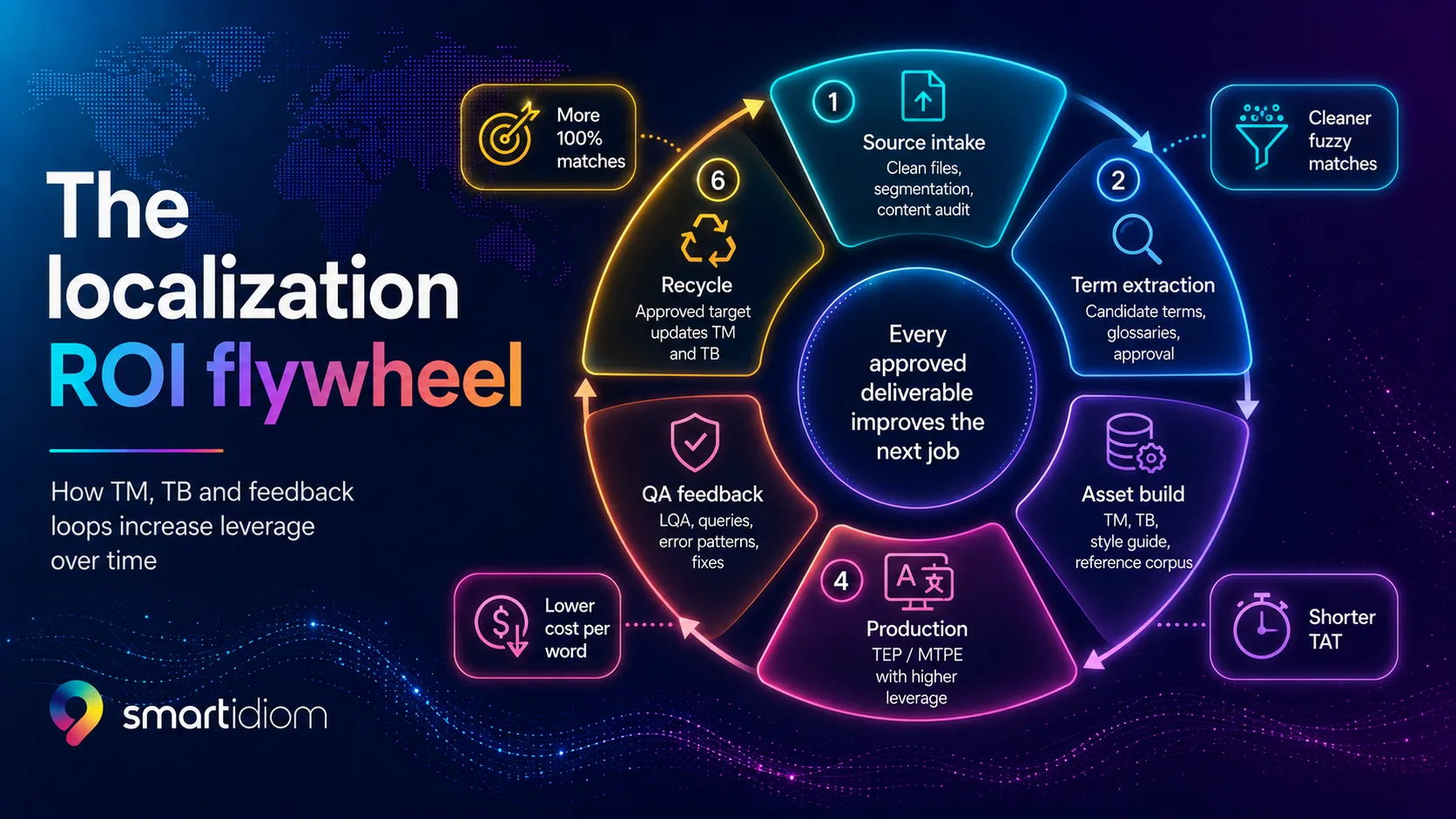
Without glossaries, translation memories, style guides and defined processes, every project starts from scratch. A supplier may deliver well once, but there is no foundation to guarantee continuity.
Consistency also has a strategic dimension. Your company may be entering new markets, launching a product, adapting documentation or preparing campaigns. If translation does not keep pace with that evolution in a controlled way, communication fragments.
For companies communicating across markets, translation should be integrated into a vision of tailored multilingual marketing strategies. It is not just about converting text: it is about maintaining a coherent presence in every language.
Where does quality control fit in a translation project?
Quality control should not be an improvised step at the end. It should be designed from the initial request, because it shapes who translates, who reviews, which tools are used and which criteria determine whether the work is ready.
Quality control means checking the translation against the purpose of the content. It covers linguistic accuracy, fidelity to the original, terminology, coherence, formatting, adherence to instructions and suitability for the audience. For critical content, it can also involve additional validation and review cycles with specialists.
A robust process reduces rework because it anticipates doubts. Instead of delivering and waiting for the client to find problems, the supplier gathers context, identifies critical terms, asks for clarification and keeps a record of decisions.
Your company should expect transparency. What checks are performed? Who approves terminology? How are later changes handled? What happens when there are several versions of the same document? These answers distinguish an operational supplier from a strategic partner.
What signs show that translation is generating hidden costs?
Hidden costs appear when translation forces your team to compensate for process failures. They do not necessarily show up as a budget line, but they consume time, delay deliveries and erode trust.

Constant rework is one of the clearest signs. If every project comes back with the same problems, the supplier is neither learning nor consolidating knowledge about your company.
Recurring delays indicate that the process is not calibrated for the volume, criticality or version management involved. Often the delay does not come from the translation itself, but from late questions, poorly planned reviews or a lack of initial alignment.
Unclear communication emerges when internal teams stop trusting the translated content. Instead of using the materials, they validate everything manually, change terms and create parallel versions.
Loss of credibility happens when clients, partners or users find inconsistencies. Even small flaws can convey carelessness, especially in sectors where rigour and trust are part of the value proposition.
If these symptoms keep repeating, the problem is not just one project gone wrong. It is a procurement model that needs revisiting.
How do you procure translation services better?
The best way to avoid these mistakes is to treat translation as a critical function of business communication. Define the risk, choose the right process and work with partners who understand your sector.
Strategic procurement starts with a clear brief. Explain the purpose of the content, the audience, the market, the deadline, the technical requirements, the existing versions and the level of validation needed. The better the initial information, the lower the likelihood of error.
Then confirm that the supplier has experience with the type of content. SMARTIDIOM, for example, has supported a European medical device manufacturer on a project that required guaranteeing compliance with the MDR and IVDR regulations across multilingual product documentation. That kind of work demands process, expertise and control, not just linguistic ability.
Finally, think about continuity. If your company will translate more content in the future, build the foundations from the first project: glossaries, memories, style guides and approval rules. That is how translation stops being a string of emergencies and starts supporting growth, consistency and market entry.
For organisations with critical content, language solutions for businesses should balance quality, risk, deadlines and compliance. That balance is what protects your message as it crosses languages, teams and jurisdictions.
Ready to procure with more confidence and quality control? Talk to us
1. Should I always choose the cheapest translation supplier?
No. Price should be weighed against risk, content criticality and the process included. If the proposal does not cover expertise, review and consistency, the initial saving can turn into rework and delays.
2. When do I need specialised translation?
You need specialised translation when the content is technical, legal, regulatory, financial or medical, or has a direct impact on the client’s decision. In these cases, linguistic fluency is not enough: you need command of terminology, context and the consequences of error.
3. How do I guarantee consistency across several languages?
Guarantee consistency with glossaries, translation memories, style guides and review processes defined from the start. It is also important to keep team continuity and record terminology decisions for future projects.