

Valid for 2026 · Updated on 31 October 2026
The short answer: for a visa, residence permit or nationality application in Portugal, foreign documents usually need an apostille (or consular legalisation) in the country that issued them, followed by a certified translation into Portuguese. Documents from EU countries may be exempt from the apostille, and documents in English, French or Spanish may not need a translation: check with the entity that will receive them.
Applications for a visa, a residence permit or Portuguese nationality are often sent back because of a single document: badly translated, not certified or missing its apostille. This guide explains which documents usually need a translation, in what order to handle each step, and how to confirm what is required before you pay for translations you cannot use.
First: the entity receiving the document decides
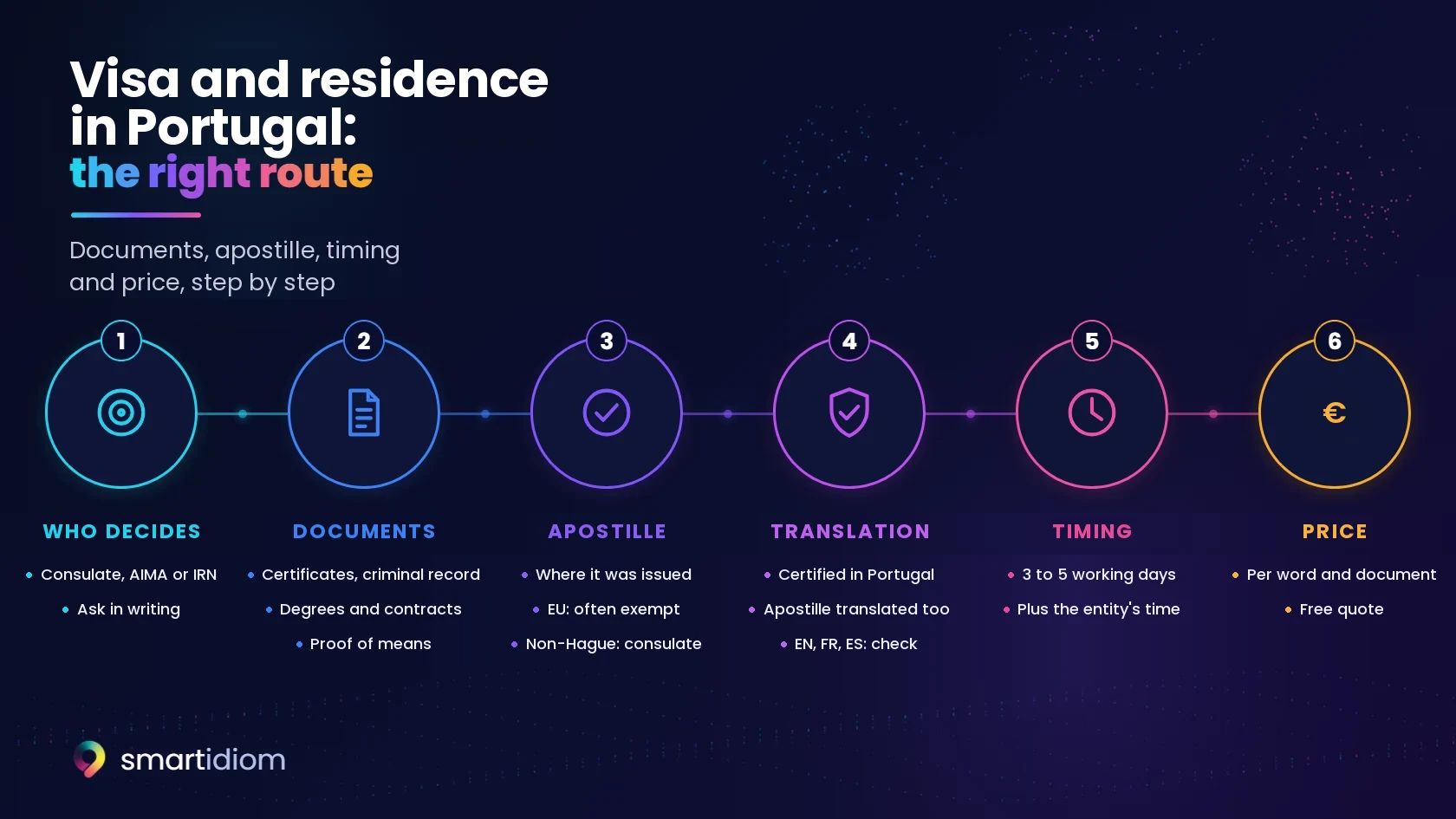
The language accepted, whether the translation has to be certified and whether the document needs an apostille are all decided by the receiving entity. If you are moving to Portugal, that is the Portuguese consulate where you apply for your visa, AIMA (the immigration agency) or IRN (the civil registry). If you are taking Portuguese documents abroad, it is the consulate, embassy or visa centre of the country you are going to. The rules change from country to country and sometimes from one application to the next. Always check the official page of that entity, or ask it for the answer in writing.
Before you order any translation, ask the entity three things: in which language, with what certification, and with or without an apostille. With those three answers, we can show you the shortest route in your quote.
Whether you are applying for a D7 visa, a D8 (remote work) visa, a golden visa (ARI), family reunification or Portuguese nationality, each application has its own list of documents, and the entity that receives it decides the details. The usual order, though, is the same: the apostille or legalisation in the country that issued the document first, then the certified translation.
The documents that most often need translating
- Birth and marriage certificates;
- Criminal record certificates;
- Diplomas and transcripts;
- Employment letters, contracts and payslips;
- Bank statements and tax returns, when you have to prove you have the means to support yourself.
A concrete example: for a residence visa for Portugal, the Ministry of Foreign Affairs asks for a criminal record certificate from your country of origin, or from the country where you have been living for more than a year, with an apostille or, if your country is not a party to the Apostille Convention, legalised.
Moving to Portugal: apostille first, then the certified translation
AIMA (Agência para a Integração, Migrações e Asilo, the Portuguese agency that handles immigration and residence) states that documents issued abroad must be authenticated and, in most cases, translated into Portuguese. The usual order is this:
- The apostille first, in the country that issued the document, or consular legalisation if that country is not a party to the Apostille Convention;
- Then the certified translation, which translates the apostille too.
The apostille cannot be added in Portugal: the Portuguese authorities, starting with the Prosecutor General’s Office (Procuradoria-Geral da República, PGR), only apostille Portuguese documents. Our guide to the Hague Apostille in Portugal explains how it works.
Before you pay for a translation, check one thing: AIMA states that documents in English, French or Spanish do not need a translation. The law it cites (Civil Registry Code, article 49(8)) waives it when the official understands the language. Other entities, and AIMA itself if the official does not understand the language, may still ask for one, so ask in writing. And if you have been asked for a “sworn translator”, our guide to sworn translation and certified translation in Portugal explains what Portuguese entities actually accept.
Taking Portuguese documents abroad
Portuguese documents are translated and certified here. The certified translation is done by a professional translator, who declares, before a lawyer, a solicitador (a regulated Portuguese legal professional) or a notary, that the translation is accurate; that professional then certifies the declaration. For certificates, see our guide to translating a Portuguese certificate for use abroad.
If the destination country is a party to the Apostille Convention (130 parties today, according to the Hague Conference), the entity will usually ask for the apostille as well. In Portugal it is issued by the PGR and its regional offices. From 1 January 2027, notaries will also be able to issue it, except for documents from the Public Prosecution Service and the courts. Whether the apostille goes on the original, on the certification of the translation or on both is up to the receiving entity.
Two exceptions that save you money:
- If the destination country is not a party to the Convention, an apostille will not help: the route is usually consular legalisation, following the steps set by that country’s consulate;
- Within the European Union, Regulation (EU) 2016/1191 exempts certain public documents from the apostille, and the multilingual standard form, which you can request together with the document, may make a translation unnecessary. If the entity still requires a certified translation of a document covered by the regulation, it must accept one made in any EU country.
Three cases we have handled
A visa for Japan, applied for from South Korea. A client needed their Portuguese marriage certificate in English for a Japanese visa, and the visa agency was asking for a “notarised” translation. We explained that the Portuguese equivalent is the certified translation, done remotely and delivered as a signed PDF, and warned that the Japanese authorities might also ask for the apostille, to confirm that the Portuguese certification is authentic. Since the agency did not ask for it, we delivered the translation without one, noting that it can be added later if needed.
The takeaway: “notarised”, “certified” and “sworn” are names other countries give to their official translations. Ask the entity exactly what it wants, and keep the apostille in mind as a possibility.
An official application in Portugal with four US documents. A birth certificate, the father’s death certificate, the parents’ marriage certificate and an FBI criminal record check, all already apostilled in the United States. Each document was translated together with its apostille and certified separately. When we reviewed the files, we noticed the marriage certificate was the church one, not the civil one, and flagged it before starting: depending on the application, the Portuguese authorities may require the civil certificate.
The takeaway: the apostille is translated with the document. And make sure you have the right document before you pay for the translation.
An IRN case from the United States. IRN (Instituto dos Registos e do Notariado) is the Portuguese civil registry and nationality authority. The client had a birth certificate and an FBI criminal record check, the latter still waiting for its apostille. We recommended sending the criminal record only once it was apostilled, because the apostille is translated with it. Because the certification in this case was on paper, on the originals, these had to reach our office in Leiria; if you would rather not send your originals, the alternative is to work from a certified copy. The turnaround only starts once the documents arrive.
The takeaway: when you apply from abroad, the time taken by the post and the apostille matters as much as the translation itself.
How long does it take?
A one-page certificate takes 3 to 5 working days for translation, revision and certification, and 5 to 7 working days if it needs an apostille, from the day you confirm your order, plus the time taken by the entity that issues the apostille, which does not depend on us. Factor this in before you book the appointment for your visa or residence application.
How much does it cost?
The price is broken down into separate items: translation with independent revision from €0.10 per word + VAT (€0.123 with 23% VAT); certification €30 + VAT per document (€36.90 with 23% VAT); apostille €40 + VAT per document (€49.20 with 23% VAT); delivery €10 + VAT within Portugal (€12.30 with 23% VAT) or €25 + VAT abroad (€30.75 with 23% VAT). The minimum is €40 + VAT per request (€49.20 with 23% VAT), applied to the whole request and not to each document. These are indicative prices and the final price may differ, depending on the turnaround, the language pair and the document itself; the calculator on our certified translation page shows which parts your case needs. The quote is free, and you get every item listed before the project starts.
Frequently asked questions
Do I need a certified translation for a visa application?
It depends on the entity receiving the document. If you are moving to Portugal, that is the Portuguese consulate, AIMA or IRN; if you are taking Portuguese documents abroad, it is the consulate, embassy or visa centre of the destination country. That entity decides the language accepted, whether the translation has to be certified and whether it needs an apostille. Check its official page or ask for the answer in writing before you order the translation.
Does the apostille go on the original document or on the translation?
It depends on the receiving entity: some ask for it on the original, some on the certification of the translation and some on both. For a foreign document coming to Portugal, the apostille is added first in the country that issued it, and the document is then translated together with the apostille.
Do documents in English need a translation for AIMA?
According to AIMA, documents in English, French or Spanish do not need a translation; the law it cites (Civil Registry Code, article 49(8)) waives it when the official understands the language. Other entities, and AIMA itself if the official does not understand the language, may require one, so check in writing.
Which documents do I need to translate for a Portuguese residence permit?
It depends on the type of permit, and the right list is the one AIMA gives for your case. The documents that most often need translating are birth and marriage certificates, criminal record certificates, diplomas, employment contracts and proof of means of subsistence, such as bank statements. As a rule, foreign documents first get the apostille or legalisation in the country that issued them (within the EU, many are exempt from this) and are only then translated. Documents in English, French or Spanish may not need a translation: check in writing with the entity before you order one.
How long does it take to translate a certificate for a visa?
A one-page certificate takes 3 to 5 working days with translation, revision and certification, and 5 to 7 working days with an apostille, plus the time taken by the entity that issues the apostille.
Do you have documents for a visa, a residence permit or a nationality application? Send us a scan and tell us which entity will receive them. You will get a quote with no obligation, with every item listed.
Sources
Checked on 31 October 2026. We review this guide every year.
- AIMA: recognition of documents
- Ministry of Foreign Affairs: supporting documents for the residence visa
- Hague Conference (HCCH): status table of the Apostille Convention
- HCCH: competent authorities of Portugal for the apostille
- Portaria (Ordinance) 452/2026/1 of 12 October (Diário da República): apostilles by notaries from 1 January 2027
- e-Justice Portal: Regulation (EU) 2016/1191 on public documents