

Translation is decisive for medical device companies because it connects safe use, regulatory compliance, market entry timelines and document control. When instructions, labelling and technical documentation are translated with specialist rigour, the company reduces risk, avoids rework and grows internationally with more confidence.
Taking a medical device international is not just adapting a product to new markets. It is ensuring that every person who evaluates, distributes, prescribes, uses or audits it receives clear, coherent information suited to their linguistic context.
In a sector where documentation follows the product’s life cycle, translation is not an administrative step at the end of the process. It is an operational and strategic decision, with direct impact on perceived quality, regulatory validation and the ability to expand.
Why does safe use start with information?
The safe use of a medical device depends directly on the information that accompanies it. Instructions for use, labelling, technical documentation and support materials guide healthcare professionals, distributors and, in many cases, end users.
When that information is ambiguous, inconsistent or poorly adapted to the market’s language, risk increases. An unclear instruction can lead to wrong interpretations; unstable terminology can confuse clinical teams; a literal translation can miss the technical or operational meaning.
Specialised translation protects the original intent of the content. It does not merely swap words between languages: it confirms terms, keeps documents coherent with one another and adapts the wording to the audience that will use, evaluate or validate the information.
In medical devices, this is particularly sensitive because different audiences read the same documentation ecosystem with different goals:
- Healthcare professionals look for clear, precise, actionable instructions.
- End users need understandable language, without loss of rigour.
- Regulatory teams check consistency, traceability and compliance.
- Distributors depend on reliable information to market the product correctly.
A weak translation can look like an editorial detail. In practice, it can create doubts about use, delay internal approvals and weaken confidence in the product.
Why does regulatory compliance demand precise translation?
Regulatory compliance does not assess only the device’s performance. It also assesses the quality, coherence and suitability of the documentation supporting that device in each market.

Requirements such as the MDR and IVDR make documentation a central element of the market access strategy. Instructions for use, labelling, technical documentation, safety materials and language versions can be scrutinised with the same rigour as the original content.
This means every translated version must accurately reflect the approved content. It cannot introduce new interpretations, omit technical nuances or alter relationships between critical concepts.
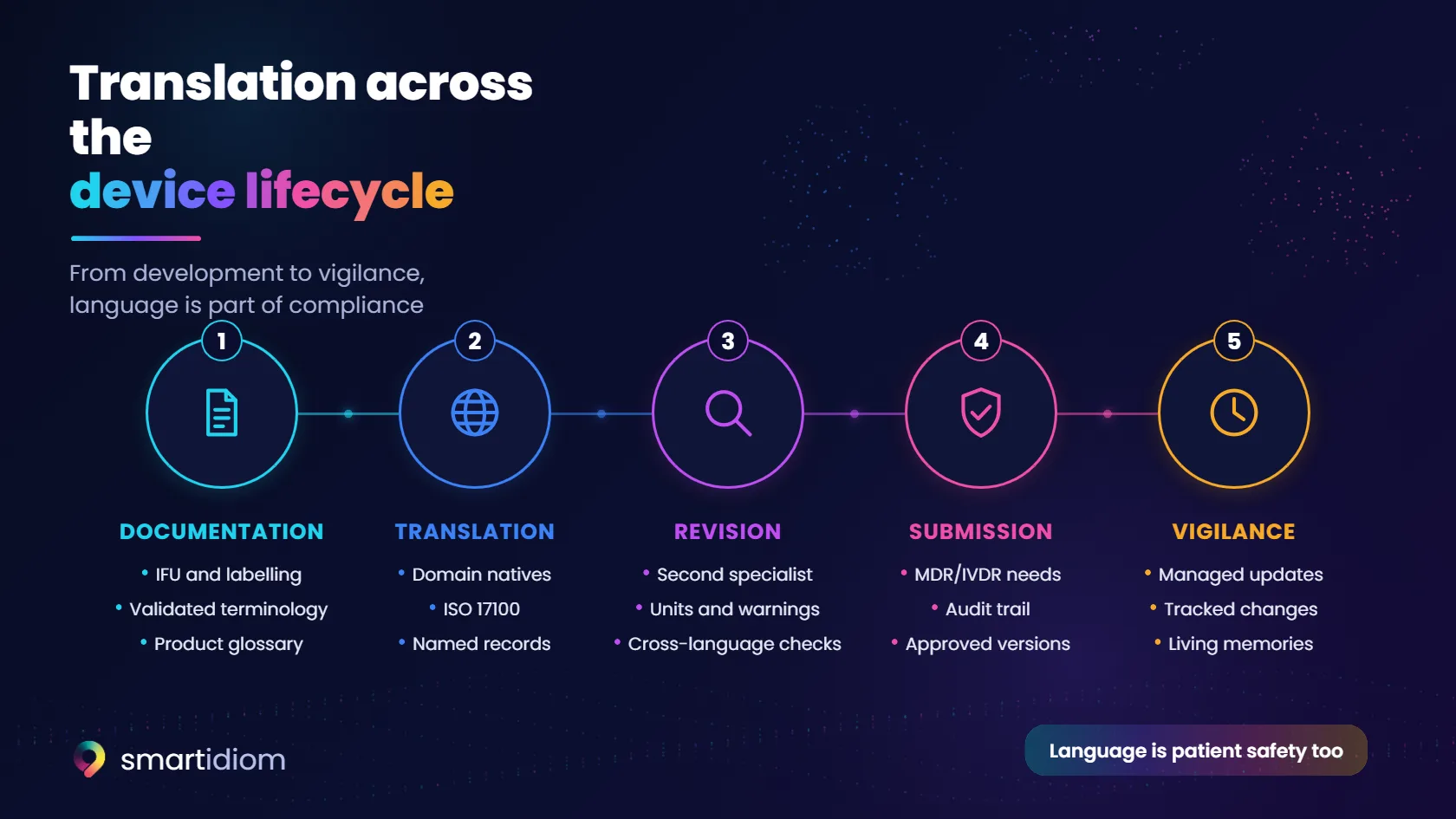
Specialised translation helps maintain that alignment. It works with native linguists with technical knowledge, appropriate review processes and terminology control to prevent drift between versions.
The difference is discipline. In a regulated environment, “looks correct” is not enough. The company needs documentation that is clear for the user, consistent for the auditor and defensible for the regulatory teams.
For companies operating in regulated markets, specialised human translation remains essential when content involves clinical risk, legal obligations or critical documentation.
How do documentation delays delay the business?
In medical devices, documentation travels with the business. Product updates, new versions, market extensions, certification processes and information requests depend on documents that are ready, reviewed and aligned across several languages.
When translation is handled at the end, as an isolated task, the risk of blockage grows. Context is missing, terminology questions pile up, versions accumulate and internal teams end up reviewing the same kind of problem again and again.
A structured approach changes this scenario. Translation becomes part of the documentation flow from early on, with clear priorities, translation memory, approved glossaries and defined validation channels.
This makes it easier to respond to frequent situations:
- Updating instructions for use without reopening the entire terminology history.
- Launching a new version while staying coherent with previous versions.
- Preparing documentation for several markets without duplicating internal effort.
- Reducing review cycles between technical, regulatory and commercial teams.
The goal is not to “translate faster” at any cost. It is to speed up the flow without compromising quality, traceability or consistency.
In medical devices, the right translation does not just speed up words: it speeds up decisions, validations and market entry.
When there is high volume, tight deadlines or repetitive content, machine translation and artificial intelligence can support specific workflows, provided they are combined with specialised human review and clear risk criteria.
Why does terminology control reduce risk and rework?
Terminology control is one of the most effective ways to reduce inconsistencies in multilingual documentation. Medical device companies deal with multiple documents, teams, versions, markets and languages at the same time.
Without terminology management, the same component can appear under different names, the same function can be described unevenly and the same warning can vary between documents. Even when each sentence looks acceptable in isolation, the whole loses coherence.
That loss of coherence has consequences. It forces internal teams to review more, increases the number of comments, creates doubts between markets and can raise questions in regulatory contexts.
A good language system should include terminology databases, translation memories and editorial instructions aligned with the approved documentation. It should also allow continuous updating, because devices evolve and the documents evolve with them.
Approved glossaries ensure critical terms are always used the same way across all documents and languages.
Translation memories help preserve wording that has already been validated, avoiding rework and divergence between versions.
Style guides define tone, structure, conventions and market preferences, keeping the content clear for each audience.
Linguistic traceability makes it possible to see what was translated, reviewed, changed and approved throughout the project.
This discipline is especially important as a company grows internationally. The more markets enter the cycle, the higher the cost of fixing inconsistencies that could have been prevented.
Which medical device documents demand the most care?
Critical documents are those where an imprecise translation can affect use, approval, marketing or support. Not all content carries the same level of risk, but all of it should sit within the company’s documentation system.
Instructions for use demand maximum clarity. They must guide concrete actions, explain warnings and preserve the technical meaning without ambiguity.
Labelling needs absolute consistency. Terms, symbols, warnings and identification information must align with the approved documentation and with the market’s requirements.
Technical documentation demands conceptual precision. Even when it is not read by the end user, it can be analysed by regulatory teams, auditors or specialised partners.
Commercial and training materials also deserve attention. A poorly adapted promise, an oversimplified explanation or an inconsistency with the technical documentation can create reputational and operational risk.
That is why medical device translation should be planned by content type, not just by language. A leaflet, an instruction for use and a technical dossier do not have the same function, the same reader or the same degree of sensitivity.
For B2B companies, translation should be part of a wider view of internationalisation, risk and time-to-market. Language solutions for businesses help connect documentation, internal processes and commercial goals without losing focus on compliance.
How should a language partnership be chosen in this sector?
A specialised language partnership makes a difference when it combines technical competence, robust processes and an understanding of the regulated environment. In medical devices, choosing a supplier on price or availability alone can prove expensive in rework, delays and documentation risk.

The right partner asks questions before translating. It needs to understand target markets, document types, the source version, terminology history, approval flows and the criticality of the content.
It should also be able to work with different teams. In many projects, translation involves regulatory, quality, product, marketing and legal departments as well as local distributors.
At SMARTIDIOM, a translation company for regulated sectors, we build trust with our clients through points we consider non-negotiable:
- Processes aligned with international quality standards.
- Native linguists with technical specialisation in medical devices.
- Experience in global projects and regulated environments.
- Support, traceability and control throughout the project.
This combination reduces friction between teams and makes deadlines more predictable. Most importantly, it allows translation to be treated as part of the documentation quality system, not as a peripheral task.
How do you integrate translation, marketing and international expansion?
The international expansion of a medical device does not end with the technical documentation. After approval, the company needs to communicate with markets, sales teams, distributors, healthcare professionals and, at times, end users.
Here, translation must stay coherent with the regulated documentation while adapting to the communication context. A product page, a sales presentation or a training asset must not contradict approved instructions, warnings or terminology.
This demands alignment between language, regulatory and marketing teams. Technical consistency must go hand in hand with clarity, local relevance and the right positioning.
Multilingual marketing does not mean making content more “creative” at the expense of rigour. It means adapting messages to the right market, in the right language, without compromising the technical and regulatory base.
When the commercial strategy depends on several markets, the marketing strategy should be built in articulation with the validated documentation. That way, the company avoids misalignment between what it promises, what it documents and what it delivers.
The same logic applies to multimedia content. Training videos, voice-overs, subtitles and accessible materials must respect the approved terminology and the level of precision the sector demands. Multimedia and accessibility services can support that adaptation when the content goes beyond the written document.
Translation is decisive because it turns technical knowledge into information that is usable, auditable and commercially effective. For medical device companies, it is a bridge between innovation, safety, regulatory compliance and international growth.
Want to prepare your medical device documentation for new markets with more confidence? Talk to us
1. Why should medical device translation be specialised?
Because it involves technical documentation, regulatory requirements and information that can influence the safe use of the product. A generalist translator may command the language, but not have the knowledge needed to preserve terminology, clinical context and documentary coherence.
2. What risks come with an inadequate translation?
An inadequate translation can create ambiguity, inconsistencies between documents, internal rework and doubts in review or validation processes. In regulated markets, these problems can affect deadlines, trust and documentary compliance.
3. When should I involve the translation partner in the project?
You should involve the language partner as early as possible, ideally before versions and languages start piling up. That makes it possible to define glossaries, approval flows and documentation priorities from the start, reducing risk and rework.