
Accessibility content helps brands grow because it removes barriers between people and information. It supports legal and ethical responsibility, improves user experience, strengthens trust and makes campaigns work harder across markets, languages and channels. For regulated B2B sectors, it is not a “nice to have”; it is part of credible communication.
When content excludes people, brands lose more than attention. They lose confidence, clarity and commercial opportunity. A video without captions, a PDF that cannot be read by assistive technology, or a form written in dense language can turn a motivated customer, patient, investor or partner away.
Accessible communication is not about lowering standards. It is about making expertise easier to receive, understand and act on. For brands working internationally, it also means adapting accessibility choices to language, culture, regulation and context – not applying one generic template everywhere.
Why does accessible content matter for brand growth?
Accessible content matters because it widens reach without diluting your message. Subtitles, transcripts, audio description, plain language and screen reader–friendly documents allow more people to engage with the same brand, product or service.
This includes people who are deaf or hard of hearing, blind or partially sighted, neurodivergent, older, working in a second language, or simply using content in difficult conditions. A caption can help someone watching a webinar in a noisy airport. A clear structure can help a busy compliance officer find the right clause quickly.
For B2B brands, the audience is rarely one person. A single buying decision may involve legal, procurement, medical, finance, technical and executive stakeholders. Accessible formats help each stakeholder understand the information they need, in the format they can use.
- Subtitles and captions make video content usable without sound.
- Transcripts turn audio and video into searchable, reusable material.
- Alt text helps explain images to users of assistive technology.
- Clear layouts reduce cognitive load and improve navigation.
- Plain language helps complex information travel further.
How does accessibility improve user experience for everyone?
Accessibility improves user experience by making content clearer, faster and easier to use. The same features designed to remove barriers for disabled users often benefit every user.

A well-structured document is easier to scan. A properly labelled form is easier to complete. A transcript makes a webinar easier to quote, translate, approve and repurpose. Captions support users in noisy environments, quiet offices and multilingual teams.
This matters because user experience is not only a design issue. It is a trust issue. If people struggle to access key information, they may question whether the brand understands their needs, respects their time or can be relied on when the stakes are higher.
In regulated sectors, clarity is especially important. Healthcare instructions, legal obligations, financial disclosures and safety information must be understandable. Accessibility helps reduce friction between expert content and the people who need to act on it.
Is Accessibility also a compliance issue?
Yes. In many markets and industries, Accessibility is linked to compliance standards, procurement expectations and organisational risk. Brands that ignore it may create legal exposure, reputational damage or barriers to public and private sector opportunities.
Compliance should not be treated as the ceiling. It is the baseline. A document can technically meet a requirement and still be difficult to use. Strong accessible communication combines legal awareness with practical readability, accurate localisation and channel-specific execution.
For regulated B2B brands, this is where the details matter. A translated policy must remain legally precise. A patient information leaflet must be clear without oversimplifying risk. A financial document must be accessible while preserving meaning, terminology and hierarchy.
Accessible content therefore requires collaboration between language experts, subject-matter specialists, designers and compliance teams. The aim is not to “decorate” content after approval, but to build usability into the communication process from the start.
Accessible content is not a separate layer of communication; it is how responsible brands make their message usable, trustworthy and ready for every audience.
Which sectors need inclusive communication most?
Some sectors face higher stakes because inaccessible content can affect safety, rights, financial decisions or access to essential services. The core principle is the same, but the consequences differ.
Healthcare and life sciences require accessible information because patients, carers and professionals depend on clear instructions, treatment information and safety guidance. A missing caption, unclear form or poorly adapted document can make already sensitive communication harder to understand.
Finance and legal content often includes contracts, policies, statements, disclosures and obligations. Accessibility helps clients understand their rights, responsibilities and risks, especially when the language is complex or the reader is using assistive technology.
E-commerce and retail brands need accessible product pages, descriptions, navigation and purchase journeys. If the buying process is difficult to use, the brand may exclude customers who were ready to buy.
Energy, defence and industrial sectors often communicate technical, operational or safety-critical information. Accessible formats help internal and external stakeholders use documentation correctly across languages, roles and environments.
How does accessible content build brand trust?
Accessible content builds brand trust because it shows responsibility in practice. It tells audiences that inclusion is not just a statement on a corporate page, but something reflected in everyday communication.
Customers, partners and stakeholders notice when a brand makes the effort to communicate with them properly. They also notice when it does not. A polished campaign loses impact if the landing page is unreadable, the video cannot be followed, or the downloadable document is unusable with assistive technology.
Trust is also built internally. Sales teams can share clearer assets. Legal teams can reduce avoidable ambiguity. Marketing teams can repurpose content more efficiently. Customer-facing teams can support a broader range of needs without creating one-off workarounds every time.
For international brands, trust depends on consistency across markets. An accessible English asset is not enough if the translated version loses structure, clarity or usability. Localisation must preserve both meaning and access.
Can accessibility create a competitive advantage?
Yes. Accessibility can create a competitive edge because many brands still treat it as an afterthought. Those that build it into strategy appear more prepared, more ethical and more user-focused.
This is particularly important in procurement-driven B2B environments. Buyers and partners increasingly expect suppliers to show maturity in communication, governance and inclusion. Accessible content supports that perception because it demonstrates operational discipline.
It also improves the performance of multilingual marketing. Searchable transcripts, structured documents, captioned videos and clear landing pages help content travel across channels and markets. Accessibility does not compete with marketing performance; it strengthens the foundations beneath it.
A forward-thinking brand does not wait for a complaint, tender requirement or legal deadline to act. It creates accessible content because it wants every relevant audience to be able to understand and engage.
- Build accessibility into briefs, not just final checks.
- Plan captions, transcripts and alt text before publication.
- Review document structure before translation and design.
- Adapt plain language to each market, not only the source text.
- Involve compliance early where legal or medical meaning is sensitive.
What does accessible multilingual content include?
Accessible multilingual content includes translation, localisation and format adaptation working together. A message may be linguistically accurate but still inaccessible if the document structure, captions, navigation or reading level are unsuitable.

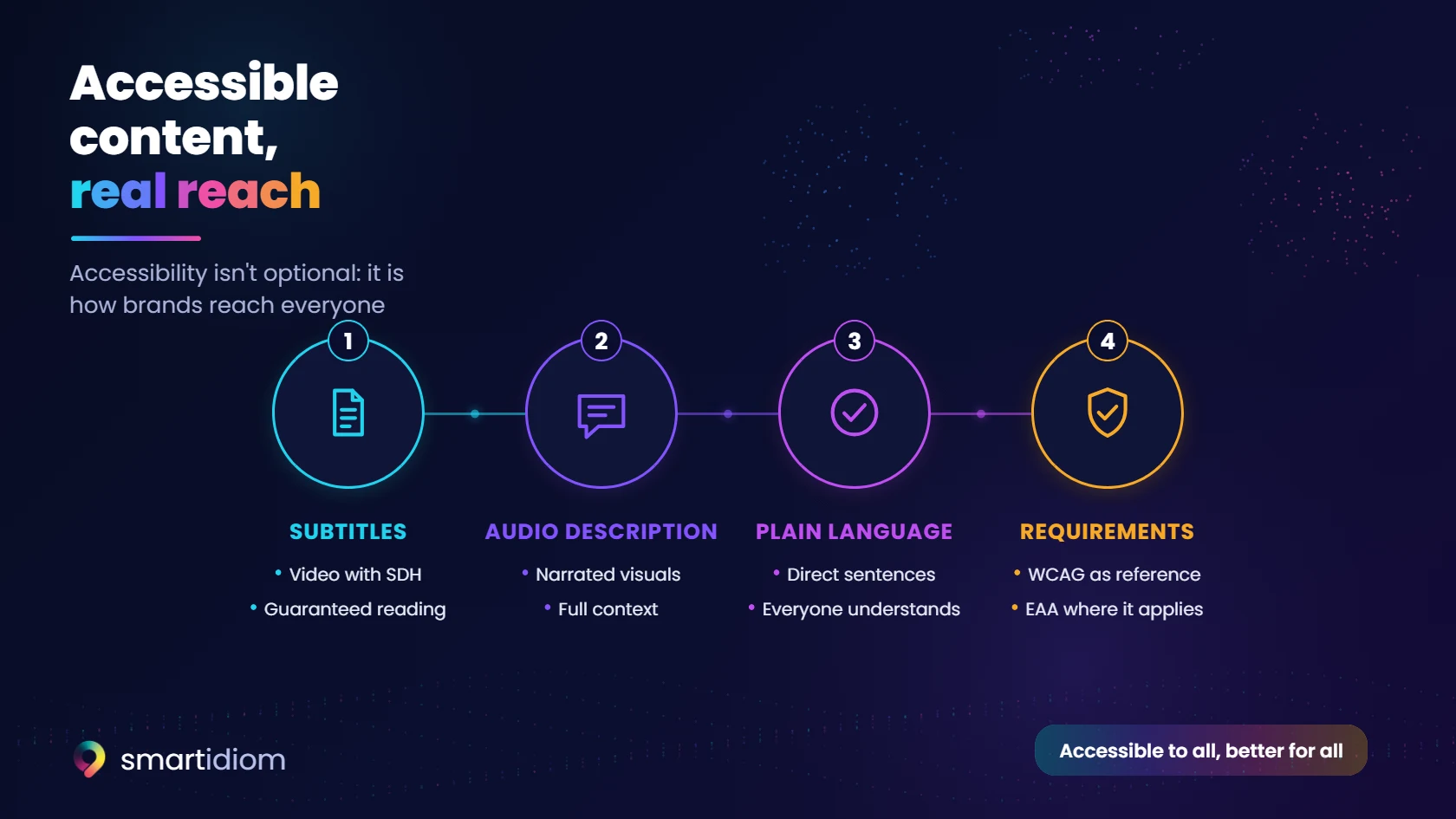
Subtitling and captioning make spoken content available to users who cannot, or prefer not to, rely on audio. Captions may also support multilingual viewers and help teams reuse video content across campaigns.
Audio description helps users understand important visual information in video content. It is especially relevant when visuals carry meaning that is not explained in the spoken track.
Screen reader–friendly formats make digital documents easier for assistive technology to interpret. This includes logical structure, correct reading order and meaningful labels.
Plain language adaptations reduce unnecessary complexity while preserving essential meaning. In regulated sectors, this requires subject knowledge because simplification must not distort obligations, risks or instructions.
Accessible design adapted to each market ensures layout, reading direction, cultural expectations and local channel behaviour are considered. Accessibility is not universal in execution; it must be localised with care.
How can SMARTIDIOM help brands make content accessible?
SMARTIDIOM helps brands make content accessible by combining specialised translation, localisation and multilingual marketing with practical accessibility solutions. This is especially valuable for B2B organisations operating in regulated sectors such as pharma, legal, fintech, defence and energy.
Our work focuses on making communication global and genuinely inclusive. That means preserving technical accuracy while improving usability across languages, formats and markets. It also means supporting teams before content is published, not simply repairing problems afterwards.
We can help with:
- Subtitling and captioning for multilingual video and webinars.
- Audio description where visual information needs to be conveyed.
- Screen reader–friendly documents and structured digital formats.
- Plain language versions of complex regulated content.
- Market-specific accessible design and localisation.
The result is communication that more people can access, understand and trust. Accessibility should be part of how your brand plans campaigns, prepares documentation and enters new markets – not a late-stage correction when something has already failed.
Ready to make your content more inclusive, compliant and effective? Talk to us
1. What is accessible content?
Accessible content is content designed so more people can use it, including people with disabilities and users in challenging contexts. It can include captions, transcripts, alt text, clear structure, plain language and formats that work with assistive technology.
2. Does accessibility only apply to disabled users?
No. Accessibility is essential for disabled users, but its benefits are wider. Captions, clear layouts, readable documents and simple navigation help busy professionals, multilingual audiences and people using content in noisy, mobile or time-pressured situations.
3. When should accessibility be considered in a content project?
Accessibility should be considered at the planning stage, before translation, design or publication. Building it into the brief saves rework and helps teams protect accuracy, compliance and user experience across every language and format.