

Surprising today’s consumers requires understanding consumer behaviour: people no longer buy just products – they buy ease, trust, relevance and coherence. The brands that stand out are the ones that personalise with judgement, communicate clearly, show authenticity and deliver a frictionless digital experience.
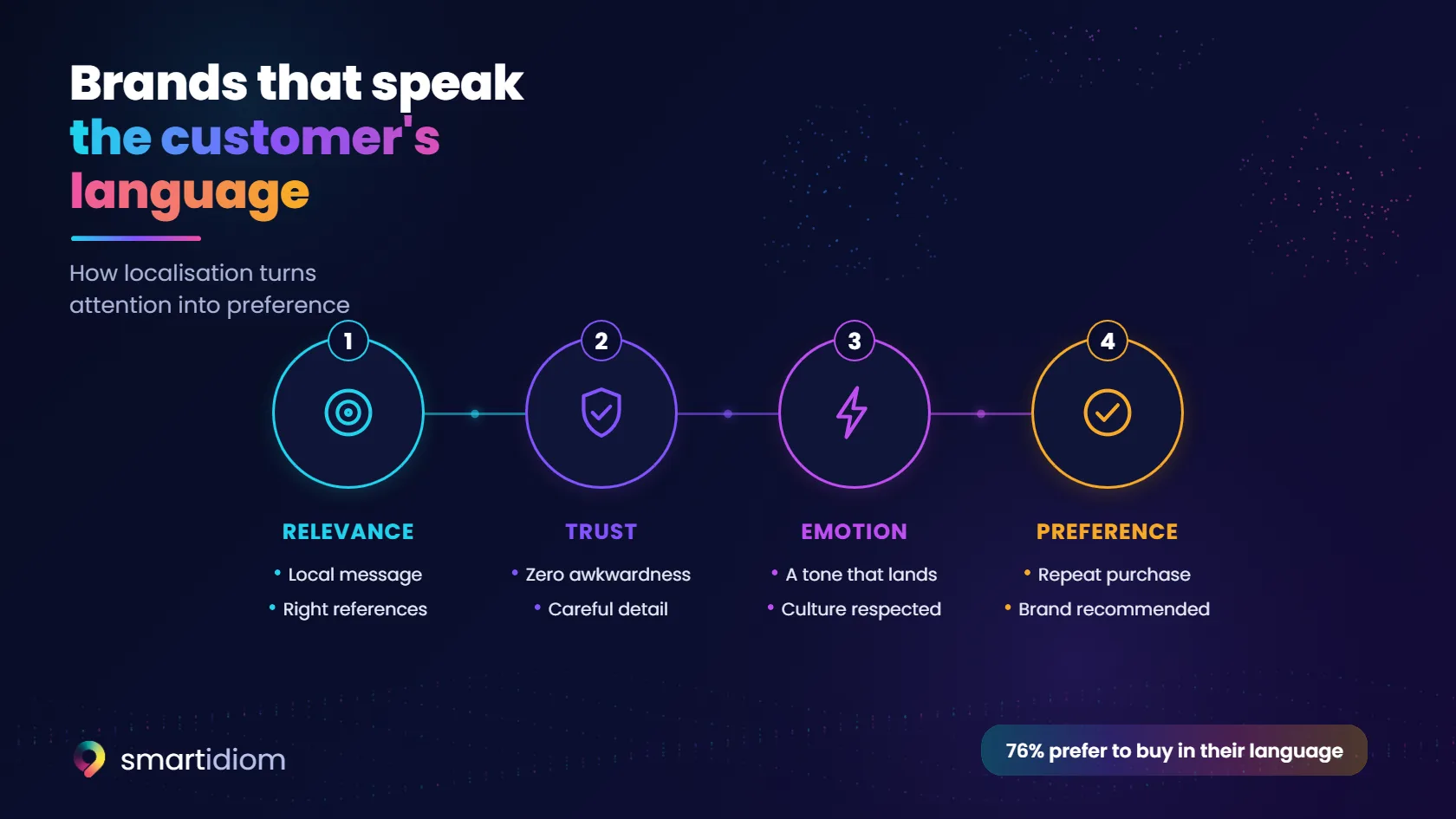
Why have consumer expectations changed?
Today’s consumer compares everything: prices, messages, websites, apps, reviews, deadlines, tone of voice and even the way a brand answers simple questions. The competition is no longer just the company next door; it is any brand offering a smoother, clearer, more useful experience.
The big shift is the demand for relevance. People expect a brand to understand their context, speak their language, anticipate needs and reduce the effort it takes to decide. When that does not happen, attention disappears fast.
This shift is especially critical for B2B companies and regulated sectors, where trust, precision and compliance weigh as much as the commercial proposition. An ambiguous message, a weak translation or a confusing digital experience can compromise an opportunity before there is even a conversation.
How does personalisation influence consumer behaviour?
Personalisation has stopped being a nice touch and become part of the minimum expected experience. Consumers do not want to feel they received the same generic message sent to the entire database; they want to see that the brand recognises their moment, their problem and their level of knowledge.

Real personalisation is not addressing someone by their first name in an email. It is adapting content, offer, language, format and communication rhythm to the behaviour and needs of the person on the other side.
For a B2B brand, this can mean segmenting messages by sector, customer maturity, geography, role within the company or stage of the buying process. A legal director does not need the same content as a marketing team, and a pharmaceutical company does not assess risk the same way an energy company does.
- Content adjusted to the decision stage.
- Messages adapted to the sector and buyer profile.
- Pages and materials available in the right language.
- Offers aligned with real needs, not internal campaigns.
Personalisation also depends on linguistic quality. When a brand enters other markets, a literal translation rarely suffices; intent, terminology and cultural context need adapting. This is where specialised human translation protects the brand’s clarity and credibility.
Why does clarity sell more than complexity?
Consumers do not want to guess, interpret or “see if they get it”. They want simple, direct, easy-to-navigate messages – from the first contact with the website to the follow-up email, the commercial proposal or the technical content.
Absolute clarity speeds up decisions because it reduces doubt. And doubt is one of conversion’s greatest enemies: if a person does not understand what the brand does, who it is for, how much value it brings or what the next step is, they are unlikely to move forward.
Being clear does not mean oversimplifying or losing rigour. It means organising information logically, using language suited to the audience and removing noise. In technical or regulated sectors, clarity matters even more, because the buyer needs to trust without getting lost in jargon.
A clear website means intuitive navigation, a visible value proposition, well-structured content and unambiguous calls to action.
A clear email means a direct subject line, one main idea, enough context and an obvious next step.
Clear content means explaining without patronising, turning complexity into decisions and respecting the reader’s time.
Surprising people today is not about communicating more; it is about communicating better, with relevance, clarity and consistency at every touchpoint.
How do you build authenticity without seeming artificial?
The strongest brands are not the ones trying to look perfect. They are the ones that communicate truthfully, consistently and humanly. Consumers quickly recognise when a brand says one thing and does another, or when it uses pretty words with no visible proof in its behaviour.
Authenticity is born from coherence between discourse, experience and decision. If a brand claims to value proximity, that has to show in customer support, in the tone of its emails, in how it explains processes and in the transparency with which it manages expectations.
Authenticity is not forced informality either. A legal, pharmaceutical or fintech company can be human without losing precision. It can write with warmth without compromising rigour. It can create an emotional connection without turning professional communication into empty chatter.
The point is simple: people trust brands that seem made by competent people, not by slogan machines. A consistent voice, clear positioning and an honest narrative make the brand more memorable.
What makes a digital experience truly seamless?
A good digital experience is one where users do not have to think too hard. They find what they are looking for, understand the message, navigate without friction and feel the brand respects their time.
The digital experience breaks when the website is slow, unintuitive, outdated, not optimised for mobile or does not speak the user’s language. And when the experience breaks, conversion is at risk.
Comparison is inevitable. Consumers judge a B2B brand with the same level of demand they apply to an app, a service platform or an online purchase. If another brand’s experience is simpler, faster and clearer, that becomes the new benchmark.
- Does the website load well and work on mobile?
- Does navigation lead naturally to the decision?
- Is critical information available in the right language?
- Is technical content easy to find?
- Do forms and contact points reduce effort?
To scale multilingual content efficiently, combining technology and human review can make sense. Machine translation and artificial intelligence are useful when there is volume, urgency and well-defined processes – as long as the final quality remains controlled by specialists.
Why does purpose have to be demonstrated?
There is a growing expectation: consumers want to feel their choices have impact. They look for brands that stand for something beyond the sale and that can demonstrate, in practice, what they claim to defend.
Real purpose does not live in an institutional sentence hidden on the website. It lives in the way the brand communicates, in the content it shares, in the stories it chooses to tell and in the decisions it makes when nobody is watching.
Saying “we are sustainable” or “we value people” is no longer enough. Consumers expect concrete signs of coherence: inclusive language where applicable, transparency about processes, accessible content, care for the experience of different audiences and responsibility in the way the brand enters new markets.
In multilingual communication, purpose also means accessibility and inclusion. Video content, subtitling, voice-over and accessible adaptations help the brand reach more people with fewer barriers. The multimedia and accessibility page is a good example of how language, format and access are part of the experience.
How do you align communication, marketing and trust?
Surprising people is not about increasing campaign volume. It is about improving the intelligence of communication: saying the right thing, in the right language, in the right format, at the moment the buyer is ready to listen.

Multilingual consistency is decisive when a brand operates in several markets. If the message changes too much between languages, the promise loses strength. If technical terminology varies from document to document, trust diminishes. If the tone feels locally strange, the brand creates distance.
That is why strategy, translation, content and design should not work in silos. The brand needs a common base: positioning, tone of voice, glossaries, key messages, quality criteria and validation processes. Then each market receives adaptation, not improvisation.
Strategy defines what the brand wants to provoke in its audience and how it will differentiate itself.
Language turns that positioning into clear, consistent, culturally relevant messages.
Design organises attention, reinforces trust and makes the experience easier to use.
Processes ensure quality holds when there is urgency, scale or multiple stakeholders.
For B2B brands, a well-designed multilingual marketing strategy helps connect communication, markets and commercial goals without losing coherence.
What should brands that want to surprise do today?
The brands that surprise start by no longer thinking only about what they want to say, and start thinking about what the consumer needs to understand, feel and do. That is the centre of the experience.
The answer to today’s consumer behaviour lies on four fronts: personalisation with relevance, clarity at every touchpoint, consistent authenticity and a seamless digital experience. To these, add purpose – which has to be demonstrated, not just declared.
Before launching yet another campaign, it is worth reviewing the essentials:
- Is your message clear to someone who has never heard of the brand?
- Does your website make the decision easier or create doubts?
- Does your communication sound human, rigorous and coherent?
- Does your content work well in other languages and markets?
- Does your purpose show in the experience or only in the discourse?
Surprising people today is not a matter of spectacle. It is a matter of intelligence, consistency and respect for the consumer’s time.
Want to make your brand clearer, more relevant and ready for multiple markets? Request a quote from SMARTIDIOM
1. What surprises consumers most today?
What surprises them most is an experience that feels simple, relevant and designed for the right person. That includes clear messages, useful personalisation, speed, coherence and a brand that delivers on its promises.
2. Can personalisation damage trust?
It can, if it is invasive, excessive or opaque. Personalisation should help the consumer, not make them feel watched; it should therefore be contextual, useful and aligned with responsible communication.
3. How do you adapt a brand to consumers in other markets?
Adaptation starts with understanding language, culture, expectations and decision context. Translating words is not enough: you need to localise messages, adjust tone, validate terminology and ensure the experience carries the same trust in every market.