

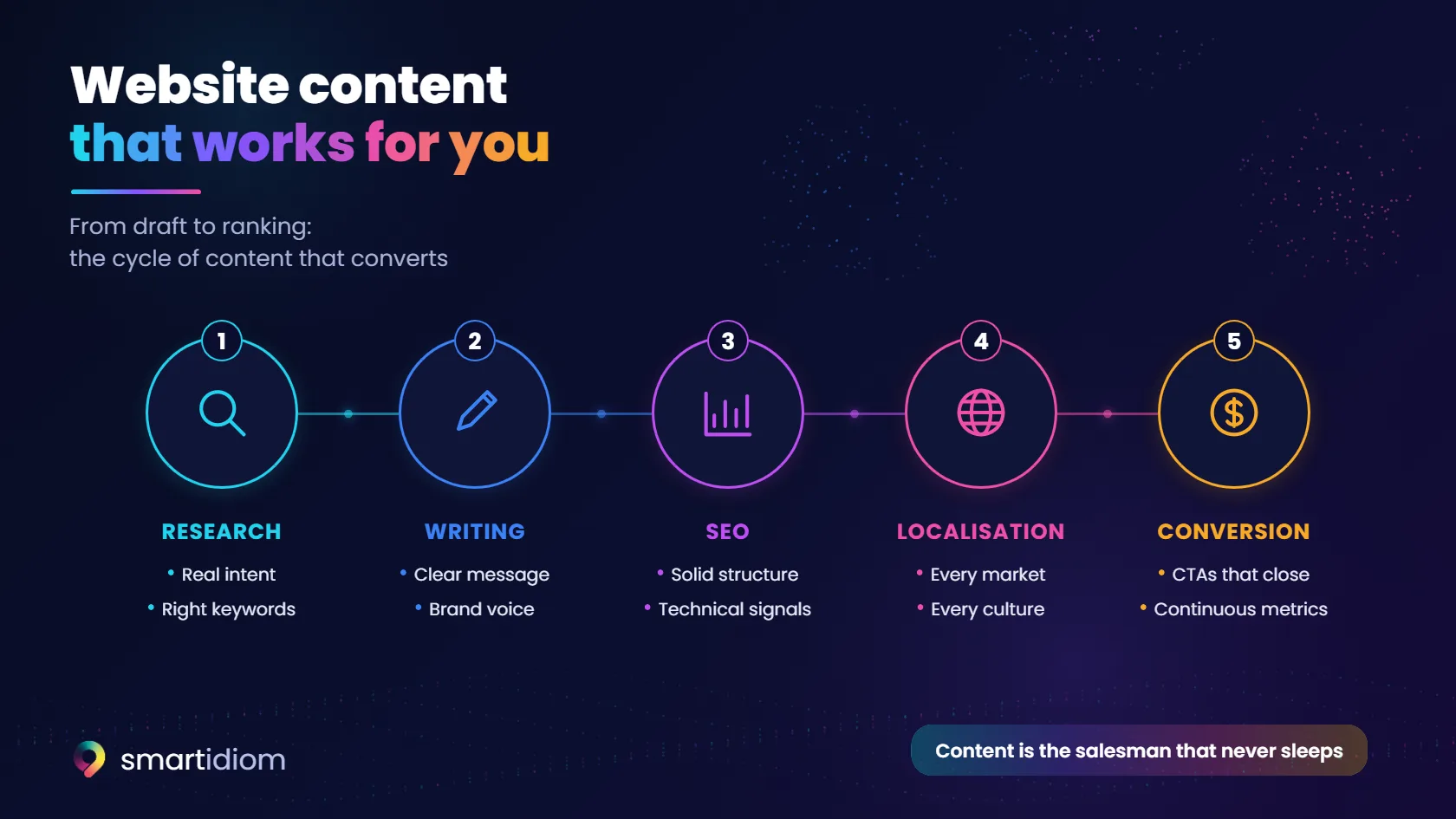
A website without fresh, useful content is increasingly invisible. Content Marketing turns your site from a static brochure into a searchable, credible and commercially useful asset: it helps people find you, understand you and trust you before they ever speak to sales.
Why is having a website no longer enough?
A website used to be proof that a company existed. Today, it is only the starting point. If the site does not answer current questions, reflect market needs or show expertise, it risks looking passive – even if the business behind it is active and capable.
Search engines and AI-assisted search experiences rely on content to understand what your company does, who it serves and which questions it can answer. A homepage and a contact page rarely provide enough context for that. Articles, insights, FAQs, case studies and guides create the signals that help your business appear for relevant searches.
For B2B companies, especially in international and regulated sectors, the issue is not volume for its own sake. The issue is strategic visibility: being present when a qualified prospect is researching a problem, comparing suppliers or preparing an internal business case.
How does Content Marketing improve search visibility?
Content Marketing improves visibility by giving search engines more relevant pages to index and more precise answers to match with user queries. Each well-planned article can target a specific topic, question, market need or keyword cluster that your main service pages cannot cover in depth.

Google rewards websites that publish high-quality, relevant content regularly. That does not mean publishing anything just to appear active. It means creating content that is useful, accurate and aligned with what your audience is already trying to understand.
Good website content supports search performance in several ways:
- It answers specific questions your buyers are already asking.
- It gives each page a clear topic and purpose.
- It strengthens your authority within a defined niche.
- It creates internal links to relevant services, sectors or resources.
- It gives your site more opportunities to appear in search results.
The commercial benefit is simple: organic discovery reduces dependence on paid visibility. Advertising can generate traffic while the budget runs, but content can keep attracting qualified visitors long after publication if it remains relevant and maintained.
What kind of content keeps buyers engaged?
Buyers stay engaged when content helps them make progress. In B2B markets, that usually means explaining risks, clarifying options, reducing uncertainty or helping stakeholders make better decisions.
Engaging content does not need to be playful or loud. For regulated industries such as pharma, legal, fintech, defence and energy, credibility often matters more than entertainment. The best content is clear, well structured and useful enough to be shared internally.
Blog articles can address common buyer questions, explain service areas or comment on industry developments. They are especially useful for capturing early-stage searches and building familiarity over time.
Industry insights show that your company understands the market beyond its own sales message. They help establish perspective, judgement and relevance.
FAQs and how-to articles reduce friction by answering practical questions before they become objections. They also help prospects self-qualify and prepare better enquiries.
White papers and downloadable guides can support more complex buying journeys. They give decision-makers a deeper resource to evaluate, circulate and return to.
A dynamic content strategy also gives existing clients a reason to come back. It turns the website into a living knowledge base rather than a digital business card.
How does content build brand authority?
Brand authority is built when a company repeatedly demonstrates expertise in public. Publishing insightful, well-researched content shows that you understand your field, your clients’ pressures and the decisions they need to make.
This is particularly important when a service is complex, high-value or difficult to assess before purchase. A potential client may not be ready to request a quote immediately, but they can judge the quality of your thinking. Content gives them that evidence.
Thought leadership is not opinion for its own sake. It should clarify a market issue, explain a trend, challenge an assumption or give a practical framework for decision-making.
Case studies show how expertise is applied in real situations. Even without disclosing sensitive details, they can demonstrate process, reasoning, outcomes and sector knowledge.
Explainer content helps buyers understand what is at stake. In specialist services, clarity itself is a competitive advantage because it reduces perceived risk.
Content is not decoration for a website; it is the evidence that your business is active, knowledgeable and worth trusting.
Authority also compounds. One strong article is useful; a coherent library of articles, guides and resources becomes a body of proof. Over time, that body of proof helps your business be recognised, remembered and shortlisted.
How does content support the customer journey?
Content supports the customer journey by answering the right question at the right stage. Not every visitor is ready to buy. Some are identifying a problem, some are comparing approaches and some are looking for reassurance before making contact.
At the awareness stage, content should help prospects name the problem. At the consideration stage, it should explain options and trade-offs. At the decision stage, it should reduce uncertainty and make the next step feel low-risk.
A practical content plan usually includes:
- Educational articles for early research.
- Comparison or explainer pieces for evaluation.
- Case studies for credibility and reassurance.
- FAQs for practical objections and pre-sales questions.
- Service-linked content that leads naturally to enquiry.
The goal is decision support, not pressure. Good content helps people move forward because they feel informed, not because they have been pushed.
This matters in B2B because decisions often involve more than one stakeholder. A prospect may need to justify a supplier choice to legal, procurement, compliance, marketing, finance or senior management. Useful content gives them material to support that internal conversation.
Why is content useful beyond the website?
A strong article does not have to live in one place. It can become material for several channels, increasing the return on the thinking and production already invested.
One blog article can be repurposed into a newsletter section, a short LinkedIn post, a sales enablement resource, a downloadable checklist or a video script. The original article remains the core asset, while other formats distribute the idea to different audiences.
This is especially useful for companies working across borders. A central piece of content can be adapted, translated or localised for specific markets, languages and search behaviours. The message stays consistent, but the execution becomes relevant to each audience.
Multichannel value depends on planning. If content is written only as a one-off post, it may be underused. If it is created as a strategic asset, it can support marketing, sales, client education and brand positioning at the same time.
What is the cost of not creating content?
The cost of inaction is not always visible immediately, but it builds over time. A static website can make a capable business appear inactive, outdated or less relevant than competitors who publish regularly.
Without indexed content, your site has fewer opportunities to rank for relevant searches. That means fewer organic visitors, fewer qualified enquiries and fewer chances to be considered at the research stage.
Common risks include:
- Lower online visibility because there are fewer searchable pages.
- A weaker brand presence if the website appears static or outdated.
- Lost leads when prospects leave with unanswered questions.
- Greater dependence on paid advertising for traffic.
- Reduced trust when expertise is not demonstrated publicly.
The most serious risk is being absent when the buyer is forming their shortlist. If a competitor has answered the question clearly and you have not, the conversation may move forward without you.
What type of content should your business invest in?
The right content mix depends on your market, buyer journey, languages and commercial priorities. A specialist B2B company does not need to publish everywhere; it needs to publish the right content in the right form, with enough consistency to build authority.
For many organisations, the strongest mix includes SEO-focused articles, industry insights, case studies, downloadable resources, practical FAQs and localised content for international audiences. Together, these formats cover discovery, credibility, education and conversion.
SEO blog articles help your site appear for specific questions and service-related searches. They are the backbone of long-term organic visibility.
Thought leadership pieces position your company as informed and commercially aware. They work best when they are specific, grounded and relevant to your buyers’ decisions.
Case studies give prospects confidence that you can deliver in real contexts. They are particularly valuable when trust, confidentiality and sector knowledge matter.
Localised content helps global audiences feel that your message is written for them, not merely translated at them. For international markets, this can be the difference between being understood and being chosen.
Why does content only scale globally in the customer’s language?
Everything above multiplies the moment your company sells beyond one market. Content that ranks and converts in Portuguese is invisible to buyers searching in German, French or Spanish – and most B2B buyers will not buy in a language they do not fully trust. Publishing consistently is step one; making that content work in every market you serve is what turns a website into an international sales channel.

That means localised keywords, adapted examples and content written – or transcreated – for each audience, not just translated word for word. A multilingual content plan lets one strategy feed every market, with each version reading as if it had been created there.
How can SMARTIDIOM help?
SMARTIDIOM creates multilingual content for B2B companies that need to be found, trusted and chosen across markets. We combine specialised translation, multilingual marketing and sector sensitivity for industries where accuracy and credibility are essential.
Our team does more than write posts. We help structure a content ecosystem: topics, formats, languages and messages that support search visibility, buyer confidence and commercial goals. That includes adapting content for different markets without diluting the brand.
For companies in regulated and specialist sectors, this matters. Content must be clear enough to engage, precise enough to trust and strategic enough to support growth. That is where Content Marketing becomes more than publishing – it becomes a business asset.
Ready to turn your website into a source of qualified trust and visibility? Talk to us
1. How often should a company publish website content?
There is no universal schedule that works for every business. The priority is consistency, quality and relevance: a realistic publishing rhythm that you can maintain is better than bursts of unfocused activity followed by silence.
2. Should B2B content be written for search engines or for people?
It should be written for people and structured so search engines can understand it. The best content answers real buyer questions clearly, uses relevant terminology naturally and helps the reader take the next informed step.
3. Do international companies need translated or localised content?
Yes, if they want to compete seriously in more than one market. Translation transfers meaning, but localisation adapts terminology, tone, search behaviour and cultural expectations so the content feels relevant to each audience.