
In the pharmaceutical industry, specialised translation is a critical factor for safety, regulatory compliance and international trust. For laboratories operating across several markets, every translated document has to preserve technical rigour, terminological coherence and traceability, because an imprecision can affect clinical decisions, regulatory submissions and the product’s reputation.
When a medicine, device, clinical trial or technical material crosses borders, language becomes part of the quality system. “Translating well” is not enough: you need to translate with method, proof, control and knowledge of the sector.
This is where pharmaceutical translation differs from generalist translation. The goal is not simply to make a text understandable in another language, but to ensure each version is technically equivalent, regulatorily acceptable and usable by healthcare professionals, authorities, partners and patients.
Why does regulatory compliance start with translation?
Regulatory compliance starts with translation because pharmaceutical laboratories operate in a highly regulated context, with products subject to authorities such as Infarmed, the EMA, the FDA or ANVISA. Each market has its own requirements, but all of them demand precision, consistency and document control.
A dossier, a package leaflet, a summary of product characteristics, a clinical protocol or a training asset does not exist in isolation. Each translated version has to align with earlier versions, reference documents, approved terminology and local requirements.
When that link breaks, the risk is not merely linguistic. There can be requests for clarification, delayed submissions, internal rework or inconsistencies that raise doubts in an audit context.
Specialised translation helps reduce that risk because it works with documented processes, qualified teams and terminology validation. In a sector where documentation follows the product’s life cycle, language has to be treated as part of regulatory governance.
How does translation protect patient safety?
Patient safety depends on clear, correct, clinically reliable information. In pharmaceutical translation, words have practical consequences: they guide doses, instructions for use, contraindications, adverse effects, diagnoses, treatments and medical decisions.

An incorrect terminology choice can change the interpretation of a procedure or make a critical indication ambiguous. Even when the error seems small, it can compromise the way healthcare professionals, carers or patients understand the information.
That is why technical rigour is not just a matter of meeting standards. It is a direct way of protecting people.
Pharmaceutical translation demands attention on several levels:
- medical and pharmaceutical terminology;
- approved formulations and standardised expressions;
- clarity for each document’s target audience;
- coherence across clinical, technical and commercial materials;
- adaptation to local requirements without losing scientific equivalence.
A text intended for a regulatory authority does not carry the same tone or function as a patient leaflet. But both demand precision. The difference lies in how the information is presented, not in the level of responsibility.
Why is consistency across languages and versions so hard?
Multilingual consistency is hard because pharmaceutical products live long cycles, with constant updates, new versions, new indications, regulatory changes and expansion into additional markets. Each change can affect several documents and several languages at the same time.
If a substance, an instruction or a warning is updated in a source document, that change has to be reflected coherently in the translated versions. Otherwise, the laboratory ends up managing misaligned information, which increases operational and regulatory risk.
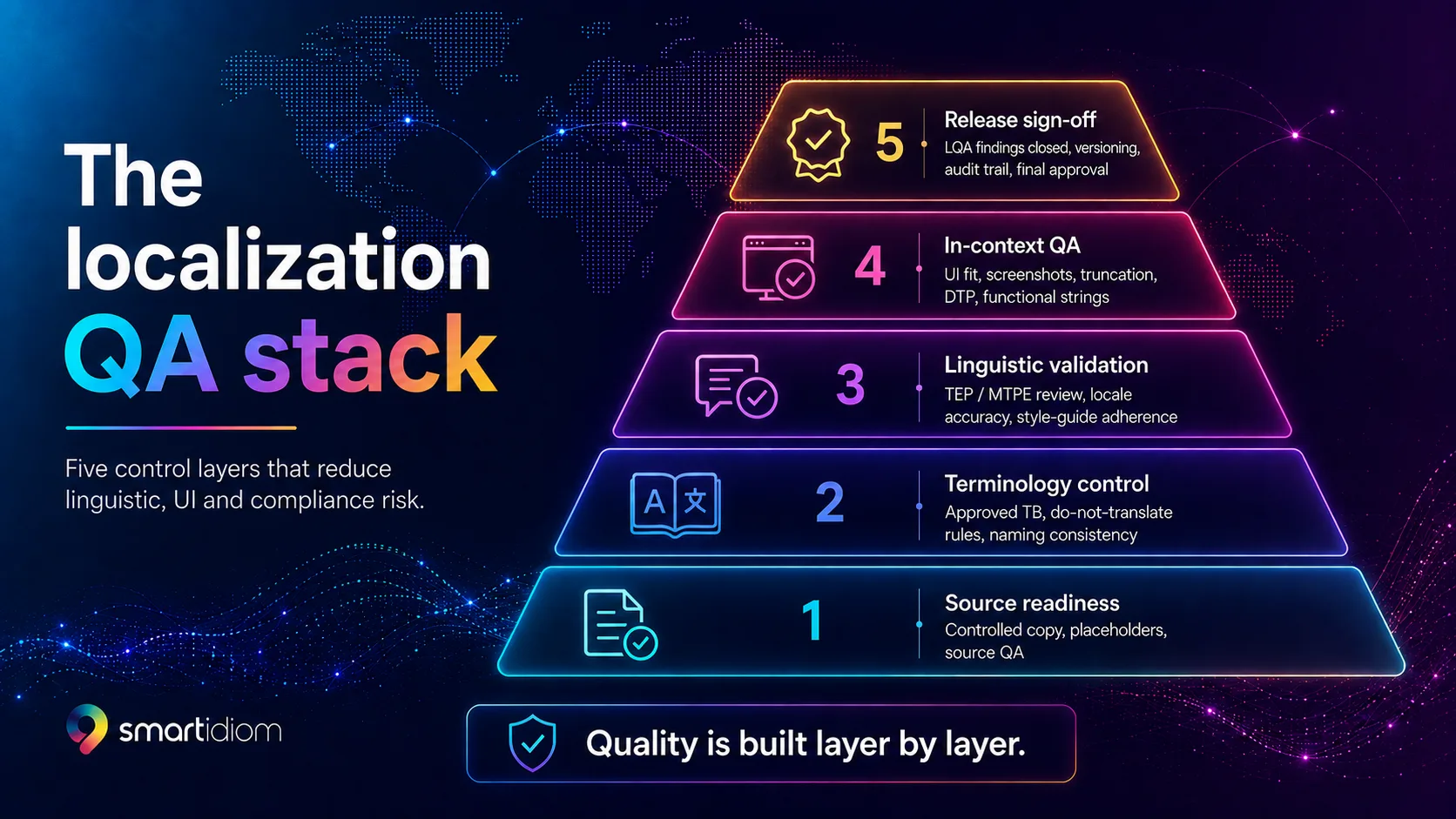
Consistency does not happen by chance. It depends on linguistic resources, institutional memory and version control.
Approved glossaries help stabilise critical terminology and prevent the same concept from being translated differently across related documents.
Translation memories make it possible to reuse validated segments, reducing unwanted variation between versions and update cycles.
Style guides define choices of tone, units, abbreviations, nomenclature and client- or market-specific preferences.
Version control ensures each change is identifiable, traceable and applied only where it should be.
For laboratories with extensive documentation, these mechanisms are essential. Without them, each project starts almost from zero; with them, the team preserves continuity, speeds up reviews and maintains trust between departments, markets and partners.
In pharmaceutical translation, quality is not just writing well in another language; it is proving that every linguistic decision is correct, consistent and traceable.
What makes a translation process auditable?
A translation process is auditable when there is full traceability: who did the work, who reviewed it, which resources were used, which decisions were taken and which version was delivered. In regulated sectors, this ability to demonstrate control matters as much as the final quality of the text.
Pharmaceutical translation should follow defined workflows, with clear stages of preparation, translation, review, quality control and delivery. This makes it possible to face audits with confidence and reduces the dependence on informal knowledge scattered across emails, loose files or undocumented decisions.
Auditable processes make it possible to:
- face audits with confidence;
- guarantee continuous quality;
- reduce operational risks;
- meet demanding deadlines without compromising rigour.
Traceability also protects the laboratory when future updates come. If it becomes necessary to understand why a formulation was chosen, what the source version was or which changes were introduced, the process must make that information recoverable.
At SMARTIDIOM, this principle is tied to certified processes, including ISO 9001, ISO 17100 and ISO 18587. In the pharmaceutical context, these references help structure quality, linguistic competence, human review and post-editing where applicable.
When does technology help – and when does it fall short?
Technology helps when it is integrated into a controlled process supervised by specialists. In pharmaceutical translation, terminology management tools, translation memories and quality support systems can increase consistency, efficiency and control.
But technology does not replace human judgement. An automatic engine can recognise patterns, but it does not carry clinical, regulatory or contextual responsibility. Nor does it understand, on its own, the impact of an ambiguity in a leaflet, a nuance in a protocol or a formulation in a document subject to an authority.
That is why the right approach is not “human versus technology”. It is technology in the service of specialised linguists.
For high-risk pharmaceutical content, specialised human translation remains central, because it involves native professionals with medical and pharmaceutical knowledge. In suitable contexts, machine translation and artificial intelligence can support workflows, provided there is qualified human review and clear applicability criteria.
The essential question must always be: what is the content’s risk? An internal support asset may justify a different approach from a leaflet, a regulatory submission or a clinical trial protocol. The decision should start from the document’s impact, not just its volume or deadline.
What human expertise does pharmaceutical translation require?
Human expertise is the centre of the process because pharmaceutical translation demands more than linguistic command. It demands native linguists with deep knowledge of the medical and pharmaceutical fields, experience in regulated contexts and command of the specific terminology.
A generalist translator can produce a fluent text, but that does not guarantee technical equivalence. In pharma, fluency without precision is not enough; precision without adaptation to the audience can also fail.
Native linguists ensure naturalness, idiomatic correctness and cultural suitability in the target language, without compromising technical terminology.
Medical and pharmaceutical specialists understand clinical concepts, therapeutic classes, instructions for use, adverse effects and the sector’s documentation requirements.
Qualified reviewers add a second layer of control, essential for spotting inconsistencies, ambiguities or deviations from the source text.
Specialised project managers coordinate deadlines, versions, linguistic resources and client requirements, keeping visibility over the whole flow.
This combination is especially important when a laboratory works in several markets at once. The language team should function as an extension of the quality system, not as an isolated supplier that merely delivers translated files.
What should a language partner guarantee for pharmaceutical laboratories?
A language partner should guarantee technical rigour, documentary consistency and the ability to work in regulated environments. For pharmaceutical laboratories, the choice of supplier has a direct impact on safety, compliance and trust in each market.

SMARTIDIOM works with B2B companies in regulated sectors and knows that pharmaceutical translation demands more than speed. It demands processes, expertise, control and clear communication with the client’s teams.
In the pharmaceutical context, SMARTIDIOM guarantees:
- certified processes, including ISO 9001, ISO 17100 and ISO 18587;
- native linguists specialised in the medical and pharmaceutical fields;
- experience in international projects and regulated contexts;
- traceability and control at every stage of the project;
- technology used as an ally, never as a substitute for rigour.
For laboratories, this means working with a team prepared to handle sensitive documentation, multilingual flows and quality demands. Translation stops being a peripheral task and becomes an integrated component of international expansion, risk management and time-to-market.
If your company needs language solutions aligned with risk, return, deadlines and compliance, language solutions for businesses should be planned from the start of the project, not only at the final publication or submission stage.
Pharmaceutical translation demands rigour, consistency, continuous specialisation and demonstrable regulatory compliance. Choosing the right language partner means guaranteeing safety, reducing risk and reinforcing trust in every market where the product is made available.
Want rigorous, auditable pharmaceutical translations ready for regulated markets? Talk to us
Frequently asked questions
1. Why shouldn’t pharmaceutical translation be treated as generalist translation?
Because it involves content with an impact on patient safety, clinical decisions and regulatory requirements. Generalist translation can be fluent, but pharmaceutical translation demands specialised terminology, traceability, qualified review and knowledge of the product’s life cycle.
2. Can machine translation be used for pharmaceutical documentation?
It can support some workflows, but it should never replace specialised human control for critical content. The decision depends on the document’s risk, its purpose, the target audience and the existence of qualified human review.
3. Which pharmaceutical documents demand the most attention to consistency?
All product-related documents demand coherence, especially when there are several versions and languages. Leaflets, regulatory materials, protocols, instructions for use, technical training and support documentation should keep terminology aligned over time.