
A strong digital experience brings customers back because it makes every interaction feel clear, natural and trustworthy. In Customer Experience, that means removing linguistic and cultural friction so people understand, decide and act without hesitation. Localisation is not cosmetic; it is what makes a digital journey feel built for the customer.
In markets where a buyer can leave with one click, the brands that win are not only the ones with the best product. They are the ones that make the path to understanding effortless. If your website, platform, app or client portal feels foreign, generic or machine-made, users hesitate. Hesitation is where conversions, trust and loyalty are lost.
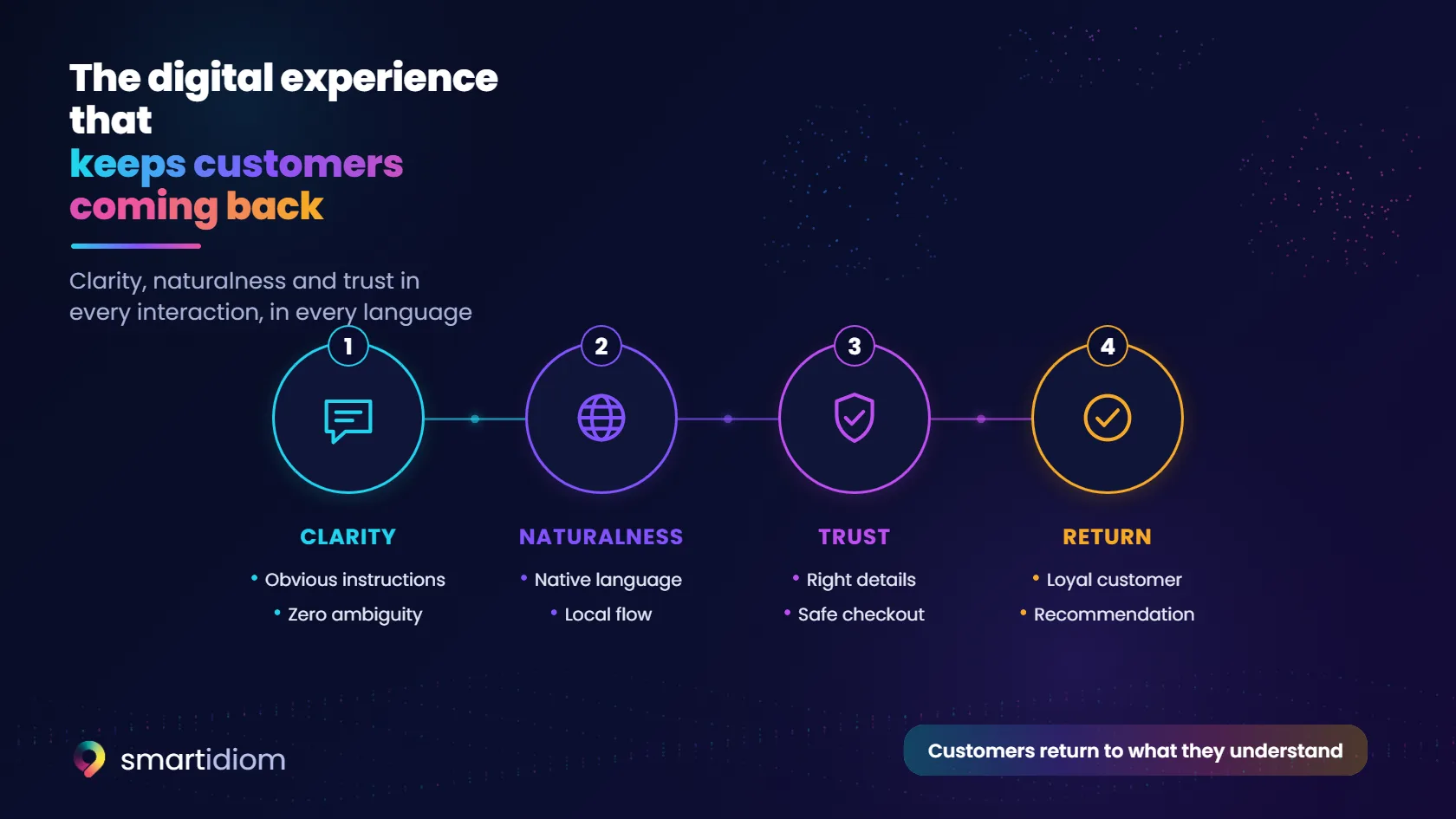
Why does digital experience decide whether customers return?
Customers return when the experience feels familiar enough to trust and simple enough to repeat. A good product may attract attention once, but a frictionless experience is what makes people come back without needing to rethink the decision.
In B2B sectors, this matters even more. Buyers are not browsing casually; they are comparing risk, reliability, clarity and credibility. In regulated industries such as pharma, legal, fintech, defence and energy, a vague message or awkward interface can make a brand look careless, even when the underlying offer is strong.
Digital experience is therefore not just a design concern. It is a business continuity concern. It affects whether people understand your value proposition, whether they trust your processes and whether they feel confident enough to move to the next step.
How does localisation remove friction from Customer Experience?
Localisation removes friction by making content, structure and tone feel native to the user’s context. A localised journey allows customers to understand your offer without translating it mentally, questioning your intent or adapting themselves to your internal language.

Customers do not want to interpret your message. They want clarity, familiarity and ease. If a call-to-action sounds unnatural, a form label creates doubt or a service description uses the wrong register, the user slows down.
That slowdown matters. In digital journeys, hesitation weakens confidence. The user may not consciously think “this is poorly localised”, but they will feel that something is harder than it should be.
Good localisation addresses several layers at once:
- Language that sounds natural in the customer’s market.
- Terminology that matches sector expectations.
- Tone that fits the relationship and level of risk.
- Interface wording that supports fast, confident action.
- Cultural references, formats and conventions that feel familiar.
This is why literal translation is rarely enough. A translated page may be understandable, but a localised experience feels usable, credible and made for the audience.
What makes a localised interface easier to trust?
A localised interface is easier to trust because it reduces cognitive effort. When users feel “at home” in a digital space, they navigate more confidently, compare options more calmly and complete actions with fewer doubts.
The best interfaces do not feel translated. They feel as if they were created for that market from the start. That is the difference between linguistic accuracy and cultural usability.
Navigation must match how users expect information to be organised. If menus, filters or help sections follow unfamiliar logic, the user may assume the service itself will be equally difficult to use.
Microcopy must guide action without sounding robotic. Buttons, error messages, confirmations and form instructions are small pieces of text, but they carry a disproportionate amount of trust.
Tone of voice must reflect the customer relationship. A fintech onboarding flow, a legal services page and a healthcare professional portal should not sound the same, even when the words are technically correct.
Terminology must align with the sector. In specialised B2B environments, imprecise language can signal weak expertise, even before a sales conversation begins.
Customers come back when the digital journey feels not translated, but built for them.
Why does familiarity build trust in competitive markets?
Familiarity builds trust because it reassures users that the brand understands their context. In a market full of polished platforms and strong products, credibility often depends on the details that make an experience feel human, consistent and relevant.
A generic digital experience is easy to ignore. A robotic one is easy to distrust. Customers may not have time to investigate why a message feels wrong; they simply move on to a competitor that feels clearer.
This is especially true when the purchase involves risk, internal approval or regulatory scrutiny. A buyer wants to know that the provider can operate professionally in their language, market and sector. Localisation becomes evidence of seriousness.
Trust is built through consistency:
- The website matches the sales material.
- The product interface matches the support experience.
- The terminology matches the customer’s sector.
- The tone matches the level of decision being made.
When these elements are aligned, the experience feels stable. Stability makes the brand easier to choose and easier to return to.
Can AI improve localisation without weakening quality?
AI can improve localisation by accelerating workflows, supporting scale and helping teams process large volumes of content faster. But AI alone cannot guarantee meaning, tone or cultural depth. The right approach is AI for efficiency and human expertise for judgement.
AI is useful when the task demands speed, consistency checks or first-pass processing. It can support terminology management, identify repeated patterns and help teams move faster across markets.
But specialised communication is not only about producing words. It is about choosing the right words for the situation. That requires context: who is reading, what they need to decide, what risk they perceive and what level of precision the sector demands.
Human linguists and localisation specialists remain essential where nuance matters:
- Regulated terminology and sector-specific wording.
- Tone of voice for high-value B2B relationships.
- Cultural expectations in sensitive or formal contexts.
- Final review of customer-facing digital journeys.
- Alignment between marketing, legal and product content.
For brands in regulated sectors, the question is not whether to use AI. The question is where AI helps and where expert human review protects credibility.
What are the warning signs of a weak multilingual experience?
A weak multilingual experience usually reveals itself through small moments of doubt. The copy may be grammatically correct, but the customer still feels that the brand is not speaking their language in a business sense.
The clearest warning sign is inconsistency. If your homepage, product pages, support articles and forms use different terms for the same concept, users lose confidence. They may wonder whether the service itself is equally fragmented.
Another warning sign is over-literal language. Literal translation often preserves words while losing intention. The result can sound stiff, vague or detached from how customers actually buy, compare or request information.
Look for these issues in your own digital journey:
- Users abandon forms because instructions are unclear.
- Local teams rewrite central content before using it.
- Support questions repeat information already on the website.
- Product terminology differs between interface, sales and help content.
- Translated pages sound correct but not persuasive.
These signals do not always point to a product problem. Often, they point to a localisation problem: the value exists, but the experience is not making it easy enough to understand.
How does localisation turn digital journeys into loyalty?
Localisation turns digital journeys into loyalty by making return visits feel natural. When customers know they can understand, act and get value without friction, they are more likely to come back. A well-localised experience creates confidence through repetition.

Loyalty is not built in one moment. It is built every time a customer logs in, reads an update, requests support, compares a service or completes a transaction. Each interaction either confirms trust or weakens it.
For B2B brands, this is where localisation becomes strategic. It supports acquisition, but it also protects retention. A customer who feels understood is less likely to look for alternatives, because the relationship is easier to maintain.
At SMARTIDIOM, we see customers returning to brands where the digital experience feels clear, adapted and culturally aligned. That is the goal: not just to be understood once, but to become the obvious choice again.
What should B2B brands localise first?
B2B brands should start with the points where confusion costs the most. The priority is not to localise everything at once, but to protect the parts of the journey where trust, action and commercial intent are highest.
Start with customer-facing assets that shape first impressions and decisions. If these pages feel unclear or generic, customers may never reach the deeper product experience.
Then move into the digital touchpoints that support onboarding, usage and retention. A strong pre-sale journey followed by a weak post-sale experience creates disappointment, and disappointment damages loyalty.
A practical order is:
- Website pages that explain your offer and sector expertise.
- Landing pages and forms linked to conversion.
- Product interface copy and onboarding flows.
- Help centres, FAQs and customer support content.
- Email sequences, notifications and account communications.
For regulated sectors, add one more layer: review any content where legal meaning, compliance expectations or technical accuracy affect customer confidence. In those contexts, localisation must be precise as well as persuasive.
Ready to make your digital experience feel built for every market? Speak to us
1. What is the difference between translation and localisation?
Translation transfers meaning from one language to another. Localisation adapts language, tone, terminology and cultural expectations so the experience feels natural in the target market. For digital journeys, localisation is usually the stronger choice because it supports usability and trust.
2. Why is localisation important for Customer Experience?
Localisation is important for Customer Experience because it removes the effort customers spend interpreting your message. When the journey feels clear and familiar, people can make decisions more confidently. That confidence supports conversion, retention and loyalty.
3. Can AI replace human localisation specialists?
AI can support localisation by improving speed and consistency, but it cannot fully replace expert human judgement. Tone, sector nuance, cultural expectations and regulated terminology still require specialist review. The best model combines AI efficiency with human expertise.