
In a crowded digital market, great copy is not decoration: it is a commercial asset. Strong Brand Messaging makes your value clear, reduces hesitation and helps the right audience trust you faster. When every sentence has a job, every click has a better chance of becoming a conversation.
The brands that win attention are not always the loudest. They are the ones people understand quickly, remember easily and believe enough to act on. That is why copywriting belongs close to strategy, sales and customer experience – not at the end of a project as a cosmetic layer.
Why does copywriting matter beyond “nice words”?
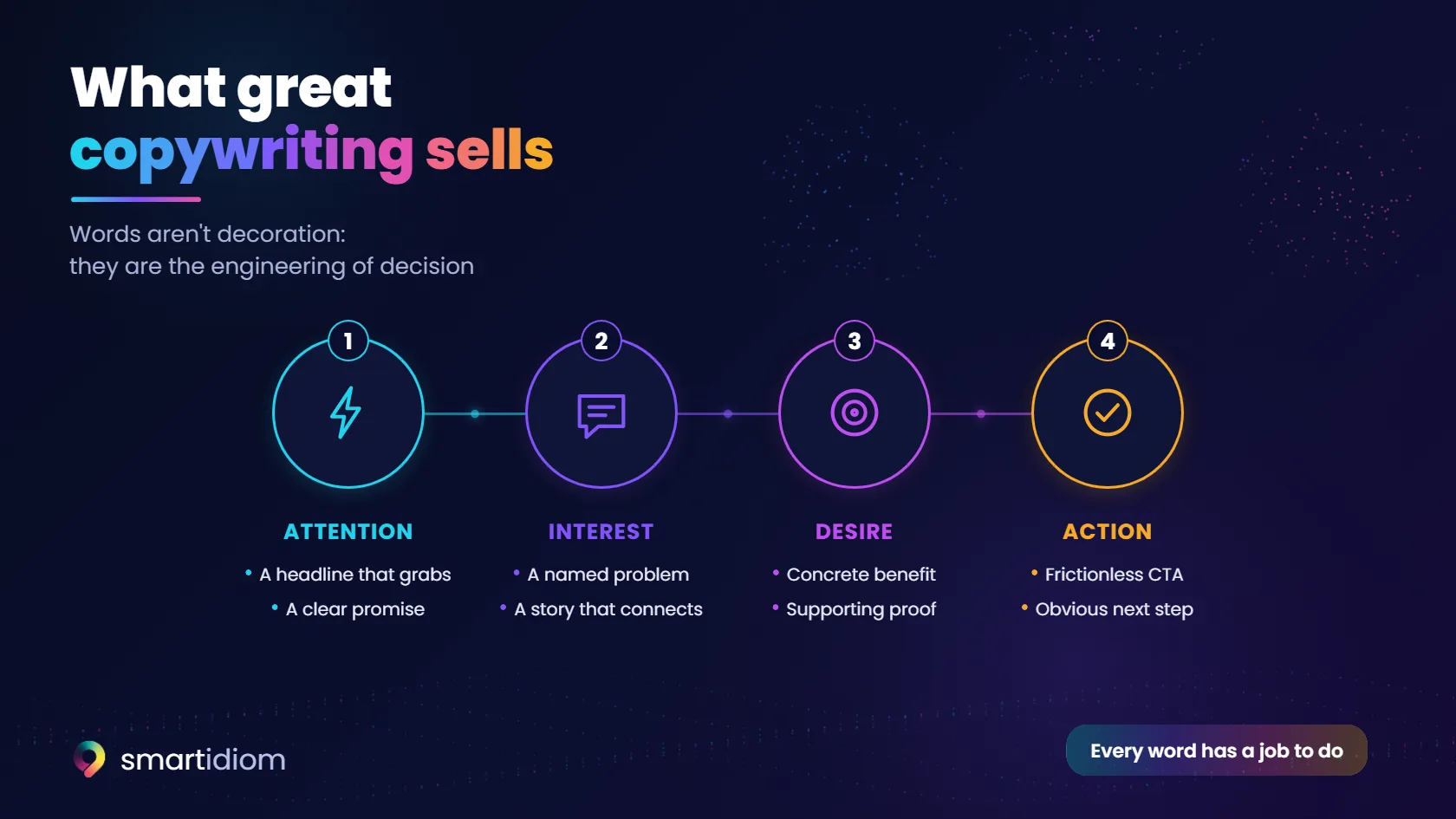
Copywriting matters because clear language changes behaviour. A sentence can spark curiosity, answer a doubt, remove a risk, create urgency or make a next step feel simple. None of that happens by accident.
Good copy does not merely describe what a company offers. It connects a business problem with a human motivation: saving time, reducing risk, protecting reputation, increasing confidence or making a complex decision feel manageable.
In B2B, this is especially important. Buyers rarely decide on impulse. They compare, discuss internally, check credibility and look for proof that a supplier understands their world. Copywriting gives them reasons to stay, read, click and return.
Weak copy creates friction. It makes a proposition sound generic, hides the real benefit behind jargon or forces the reader to work too hard. Strong copy does the opposite: it respects attention and moves the decision forward.
What is Brand Messaging supposed to do?
Brand Messaging should make it instantly clear who you help, what you solve and why your approach is worth trusting. It is the foundation that keeps websites, campaigns, sales materials and multilingual content aligned.

It is not a slogan exercise. A message platform should guide practical decisions: which benefits lead, which objections need answering, which tone fits the audience and which words should be avoided because they blur meaning.
For regulated sectors – pharma, legal, fintech, defence and energy – this clarity is not optional. The message must be persuasive without overclaiming, technically correct without sounding cold, and commercially useful without weakening compliance.
A strong messaging system usually clarifies:
- The core value proposition in plain language.
- The priority audiences and their decision triggers.
- The proof points that support trust.
- The tone of voice for different channels.
- The terms that must be adapted for each market.
When this work is missing, every new asset starts from scratch. Teams rewrite the same ideas, agencies interpret the brand differently and local markets improvise. The result is inconsistency – and inconsistency costs attention.
Where does copywriting create business impact?
Copywriting creates impact wherever a reader has to make a decision. That decision may be small – opening an email – or substantial – requesting a proposal, booking a demo or trusting a technical supplier.
Websites need immediate clarity. A visitor should understand what you do, who it is for and why it matters before they lose patience. Headlines, page structure and benefit-led copy turn passive browsing into qualified enquiry.
Landing pages need focus. Every element should support one action, from the headline to the form prompt. Copy should reduce uncertainty, remove distractions and make the next step feel low-friction.
Ecommerce needs confidence. Product descriptions should go beyond specifications and explain fit, use, value and reassurance. Even in B2B procurement, buyers are still looking for clarity before commitment.
Email campaigns need precision. Subject lines, preview text, opening lines and calls-to-action all influence whether a message is opened, read and clicked. Small wording choices can change the way an offer is perceived.
Social media needs consistency. Posts should strengthen the brand, invite interaction and sound recognisably like the same company across markets and formats. Visibility without coherence does little for trust.
B2B materials need credibility with a human tone. White papers, brochures and case studies must be rigorous enough for experts, but clear enough for decision-makers who do not have time to decode complexity.
Great copy does not make a weak offer look better; it makes a strong offer easier to understand, trust and choose.
Why is multilingual copy different from direct translation?
Multilingual copy is different because resonance is cultural, not just linguistic. A direct translation may preserve the words while losing the intention, rhythm, emotional weight or commercial force of the original.
This is where many global brands weaken their message. A phrase that sounds sharp in one language may sound exaggerated in another. A call-to-action that feels natural in one market may feel too aggressive, vague or unfamiliar elsewhere.
For specialist and regulated sectors, the challenge is even greater. The copy must respect terminology, local expectations, legal constraints and audience sophistication. Accuracy and persuasion must work together.
Effective multilingual copy asks:
- What does the audience already know in this market?
- Which claims, terms or tones may need adaptation?
- What level of technical detail builds trust here?
- Does the call-to-action feel natural in this language?
- Is the local version still recognisably the same brand?
At SMARTIDIOM, this is why we treat adaptation as a strategic act. Native copywriters and sector-specific specialists do more than convert text. They protect meaning, intent and credibility across languages.
Why should strategy come before creativity?
Strategy should come first because creative copy only works when it is aimed at the right audience with the right purpose. Clever words are not enough if they answer the wrong question.
Before writing, the useful work is listening: understanding the business goal, the buyer journey, the objections, the competitive context and the role of each asset. A homepage, brochure, product page and nurture email should not all say the same thing in the same way.
Research also protects teams from internal assumptions. Companies often speak from the inside out: features, processes, internal terminology and corporate phrasing. Customers read from the outside in: problems, risks, outcomes and proof.
A strategy-first process gives copywriters the material they need to choose wisely. The aim is not to sound more polished. The aim is to make every word support a commercial and reputational objective.
That balance matters in specialist sectors. Language has to be precise enough for technical scrutiny, clear enough for busy decision-makers and persuasive enough to move action forward.
What makes professional copywriting measurable?
Professional copywriting is measurable because reader action can be observed. The exact metric depends on the channel: enquiries, clicks, downloads, form completions, demo requests, qualified leads or engagement with sales materials.

Not every result is immediate, and not every benefit fits neatly into a dashboard. Clarity also improves consistency, reduces internal rewriting and gives sales teams sharper language to use in conversations. Those gains compound across campaigns and markets.
What matters is to connect copy with purpose before writing begins. A page built to educate should not be judged like a landing page built to convert. An awareness post has a different job from a proposal introduction.
Useful copy objectives include:
- Make a complex offer easier to understand.
- Increase confidence before a sales conversation.
- Reduce hesitation at a conversion point.
- Differentiate a brand in a crowded category.
- Keep multilingual campaigns aligned across markets.
The difference between average and excellent copy often appears in small moments. A clearer headline keeps someone reading. A sharper proof point builds confidence. A more specific call-to-action turns interest into movement.
How does SMARTIDIOM approach copywriting for specialist brands?
SMARTIDIOM combines linguistic expertise with sector understanding. We write for organisations where language has to be persuasive, accurate and appropriate to the level of risk in the market.
We do not write blindly. We start by understanding your goals, your audience, your buying process and the role each asset plays. Then we shape copy that supports the journey from first contact to decision.
Our work is especially relevant when brands need clarity across languages. Native copywriters and specialists help ensure that your message is not only correct, but compelling in the market where it will be read.
The process is practical: clarify, write, adapt, refine. Whether the output is a website, landing page, email sequence, social campaign, brochure or case study, the aim is the same – to connect meaning with action.
Great copy is not about sounding bigger than you are. It is about making your value easier to see, easier to trust and easier to choose.
Ready to make your Brand Messaging work harder in every market? Talk to us
1. What is the difference between copywriting and content writing?
Copywriting is usually written to drive a specific action, such as a click, enquiry, download or purchase. Content writing often focuses on informing, educating or building authority over time, although the two can overlap in B2B marketing.
2. Why not just translate our existing marketing copy?
Direct translation can preserve literal meaning but miss cultural nuance, emotional impact and market expectations. Multilingual copy should adapt the message so it feels natural, credible and persuasive in the target language.
3. When should a company invest in professional copywriting?
Invest when your offer is strong but difficult to explain, when campaigns are not converting as expected, or when different teams and markets describe the brand inconsistently. Professional copywriting brings clarity, structure and commercial intent to the words your audience sees.