
Industry/Sector: Fintech, Crypto & Financial Services
A bank’s annual report and accounts is mostly numbers. There are the financial statements, the notes to the accounts and the audit reports, with a good deal of company-law text in between. The people who read it next are auditors, supervisors and investors, and they check it line by line.
SMARTIDIOM, a translation company specialising in financial services, translated the annual report and accounts of a large European banking group from Spanish into Brazilian Portuguese. The request came from a partner translation agency. Between late July and early October 2026 we translated the accounts for four financial years, in two projects. The second came about because the first had gone well.
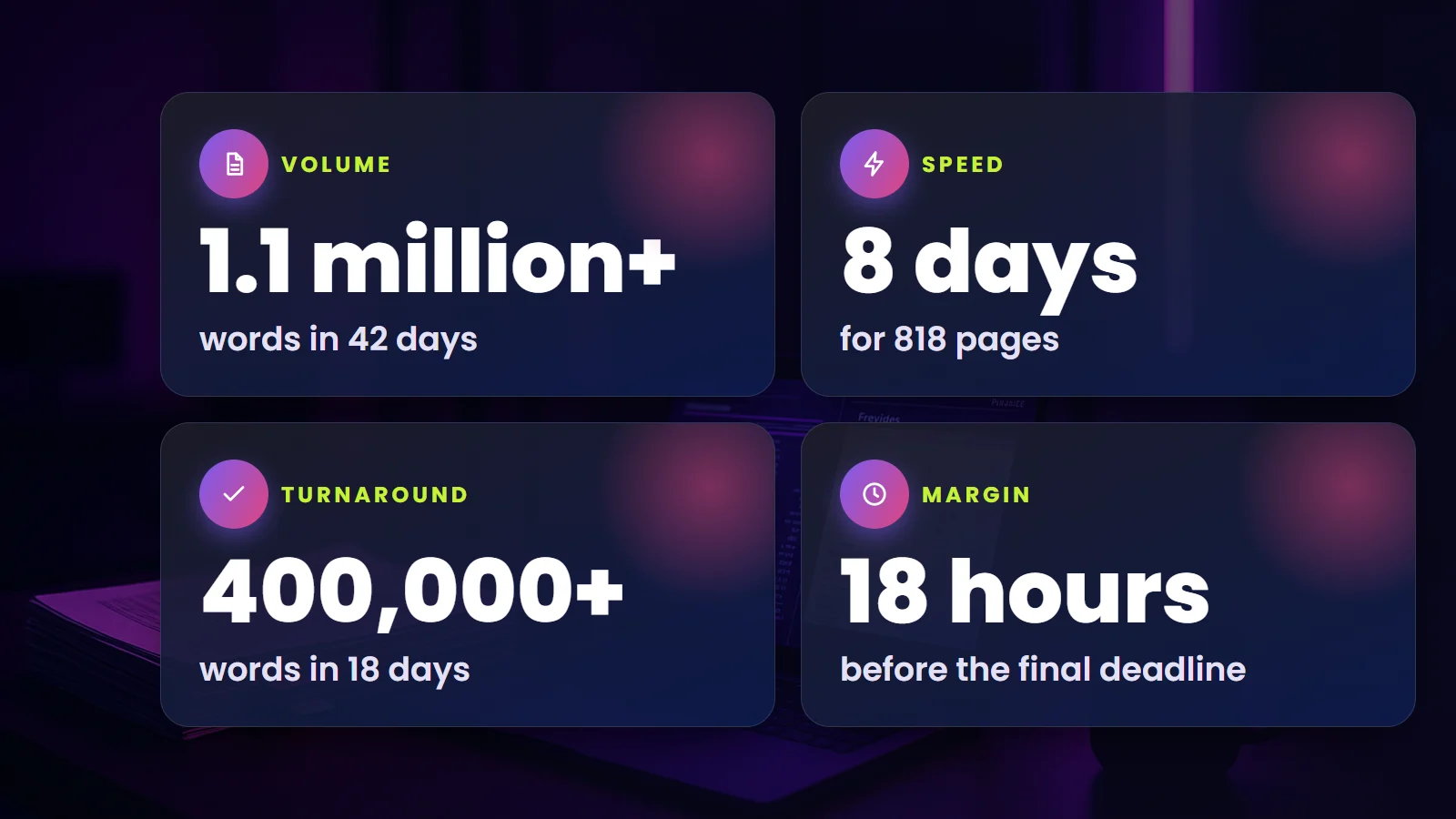
In short: in two projects between July and October 2026, we translated more than 1.1 million words of a large European banking group’s annual report and accounts from Spanish into Brazilian Portuguese, in 42 calendar days of work, with a final review every day. The last batch went out about 18 hours before the final deadline.
The challenge
- A lot of text and little time. The first project was about 700,000 words, more than 400,000 of them in the 2025 accounts alone, which the bank wanted before anything else. The 2026 quarterly reports and the 2024 accounts followed. At the end of September the 2023 accounts arrived: 818 pages, about 449,000 words, to be done in eight calendar days.
- Dates set by other people. Every deadline depended on whoever came after us: the auditors, the bank’s internal review and, in the second project, a final deadline that could not move.
- Audited accounts. Figures and units have to tally, the terminology is that of banking and company law, and the same term has to come out the same way every time, whatever the batch, the document or the financial year.
- Reviewers on the bank’s side. The end client had the translation independently reviewed in Brazil, by people who work in Brazilian Portuguese every day.
SMARTIDIOM’s strategy
1. Getting everything moving in a day
Just over a day passed between the first e-mail and the purchase order. We held a video call on the afternoon of the first contact and, by the end of that day, the schedule was already being negotiated with the end client. The terms were agreed the next morning.
2. Opening the files before starting
Before anyone translated a single line, we ran a technical check on the files. One of them had been set up with the wrong language pair. We told the partner, who sent a replacement 25 minutes later, before any translation had started.
3. Daily review and quality control
We worked with a team of translators and revisers, a final reviewer dedicated to quality control and two project managers. The final reviewer, a native linguist from our in-house team, read the team’s work on the day it was delivered, paying particular attention to banking terminology, to the figures and to consistency across batches.
The project managers looked after the schedule and spoke to the partner every day. Every query was logged in a shared file. At one point, the review found an inconsistency in the source text itself, and we flagged it to the partner.
4. Delivering first what was needed first
The end client set the order of deliveries. In the first project, the 2025 accounts went out before anything else. In the second, we started with the text in the images and moved straight on to the accounts and the audit reports, because that was what the auditors were waiting for.
5. A second project that started with work already done
We carried the translation memories, the terminology and the bank’s language preferences over from one project to the next. When the 2023 accounts arrived, more than 65% of the text already had high fuzzy matches in those memories. And the team already knew the style the Brazilian reviewers liked.
From the first e-mail to the last delivery
- 29 July. The first e-mail arrives late in the morning and the video call is in the afternoon. By the end of the day we are negotiating dates with the end client: 17 August, 24 August and 3 September.
- 30 July. The schedule is approved and the purchase order arrives. The file check turns up the file with the wrong language pair, which the partner replaces in 25 minutes.
- 3 to 7 August. With review every day, the priority batch goes from about 15% to 57%.
- 17 August. After a weekend of work, the 2025 accounts go out on Monday morning. At noon the partner’s queries arrive, and by 5.20 pm the revised version has been sent.
- 24 August. The 2026 quarterly reports go out on the agreed day.
- 27 August. We receive the outcome of the independent review by the bank’s Brazilian reviewers: a few corrections, mostly to pagination, and style preferences to apply in the next file.
- 2 September. We deliver the 2024 accounts a day early, already with the bank’s preferences applied. Over the next two weeks, the order is extended four times.
- 28 September. The partner comes back, this time with the 2023 accounts: 818 pages, about 449,000 words, with a fixed deadline.
- 29 September. Late in the afternoon, still without formal approval, we are told to start. The green light for the whole project comes the next day.
- 30 September. The work is split into five batches, each with its own deadline. The text in the images goes out that night.
- 2 October. On Friday evening, as agreed, the accounts and the audit reports (276 pages) go out.
- 5 October. We deliver the corporate governance section, 181 pages, on a public holiday in Portugal, after another weekend of work.
- 7 October. In the morning, ahead of the agreed time, the business model and sustainability section (284 pages) goes out. In the late afternoon the last batch follows, risks and glossary, about 18 hours before the final deadline.
- 8 October. The partner delivers everything to the bank and writes to thank us.
Challenges overcome
- Starting before approval. In the second project, formal approval had not yet arrived and the schedule could not wait. We started that afternoon, with the partner’s written agreement. Approval came the next day, with the work already under way.
- Deadlines that moved mid-project. The partner asked us to bring the final delivery forward by a day, without being able to push back the auditors’ batch. We told them honestly that it could be done, but that it would be “a real marathon”, and we adjusted delivery times batch by batch. To make it, the team worked through weekends in both projects.
- Independent review on the client’s side. The most demanding readers were the bank’s Brazilian reviewers. Across more than 400,000 words they sent back a few corrections, mostly to pagination, and style preferences that we applied straight away in the next file and in the second project.
Key performance indicators achieved
- More than 1.1 million words of annual report and accounts, in two projects, between July and October;
- More than 400,000 words delivered 18 calendar days after the start, with the revised version sent on the same day the queries arrived;
- 2024 accounts delivered a day ahead of the deadline;
- Four extensions to the order in two weeks, and a second project from the same partner;
- 818 pages of the 2023 accounts in eight calendar days, with the last batch delivered about 18 hours before the final deadline;
- Only a few corrections, mostly to pagination, in the independent review carried out in Brazil.
Conclusion
Looking back, both projects rested on a few things. The team was in place the day after the first e-mail. Review kept pace with the work every day. Deliveries followed the order the bank needed. And when the partner came back with the 2023 accounts, the memories and terminology from the first project were already there. That is how we offer annual report translation and other financial translation to any language service provider or business with a lot of text to translate, little time and documents that have to be right.
What this client says
“Solo escribía una breve línea para agradecerte a ti y a todo el equipo el esfuerzo que habéis hecho para que este proyecto salga adelante y en tiempo récord.”
I just wanted to drop you a quick line to thank you and the whole team for all the effort you’ve put in to get this project over the line, and in record time.
Project management at the partner agency, by e-mail
“Habéis hecho un trabajo excepcional, se nota que el documento está bastante trabajado.”
You’ve done an exceptional job; you can tell a lot of work has gone into the document.
Project management at the partner agency, by e-mail
Under our confidentiality commitment, we do not identify the partner or the end client. We give the same protection to everyone who works with us.